Showing posts with label Science Fiction. Show all posts

Friday, May 25, 2012

The Lucky Thirteen

For those of you who have not been keeping detailed track, I've posted reviews for 74 major science fiction award winners, which means I have 13 left to read and review. This small number (including eleven Hugos, one Nebula, and one Hugo-and-Nebula) would make you think that the end is reasonably in sight.

Avid readers of this blog may have noticed, however, that the average elapsed time between book reviews has been growing. I assure you, dear reader, that this is through no waning of my interest in the subject matter.

It is certainly due in part to an increase in the chaos and busyness of both my life and my day job (destroying worlds, of course). But it is also due to the intrinsic nature of the remaining books themselves. I have managed to whittle myself down to thirteen books that are, for one reason or another, particularly difficult to get through. To wit:
  • The book is enormous (Blackout/All Clear, Jonathon Strange
  • I am 8th in line for a hold on two library copies (Among Others)
  • The book has been checked out or missing from my library for a long, long time (Hyperion, Spin, The Snow Queen
  • The lone copy at my library is in-library use only (Double Star, Cyteen, Uplift War)
  • The book is part of a series that I dread reading another installment of (The Vor Game
  • The book is by an author that I dread reading again (Rainbow’s End, The Graveyard Book
  • I dread reading the book for other reasons (Harry Potter and the Goblet of Fire
I trust the reader will understand if my productivity slows still further as a result of these circumstances. But have faith: the thirteen will be completed. And then... who knows what. Perhaps it will be on to the nominees!

Friday, May 18, 2012

Book Review: The Demolished Man

Alfred Bester
1951
Awards: Hugo
Rating: ★ – – – –

SPOILER ALERT

A Demolished Man is tolerable until about two-thirds of the way through, and then it falls apart in a frustrating mass of pretentiousness and 1950s-era pop psychology.

The book takes place in the late 21st century, after humans have colonized the moon and several nearby planets. Evolution and training have brought about a new small but powerful minority: people with ESP, or “Espers,” who can read the thoughts of others.

There is no crime anymore, since Espers can tell when one is about to be committed and prevent it from happening (Similar to the premise of Philip K. Dick’s Minority Report, which came out five years later).

There are three classes of Esper, from the rudimentary and common class 3 up to the powerful and rare class 1. All Espers of all classes belong to a self-regulating Guild which prevents them from “peeping” people without their permission and otherwise using their abilities for evil.

In this world lives Ben Reich, president of the behemoth Monarch Utilities & Resources corporation. Reich is engaged in a heated battle for world capital domination with Craye D’Courtney of the D’Courtney Cartel. He is also haunted by nightmares of a mysterious Man With No Face which cause him to wake up in the middle of the night, screaming.

At the beginning of the book, Reich sends a coded message to D’Courtney proposing a merger. D’Courtney accepts, but Reich mis-decodes his answer as a refusal, and determines that the only thing he can do to preserve Monarch is to kill D’Courtney (which seems like a bit of a leap, but I guess Reich’s nightmare-addled sleep may be impeding his logic).

Reich constructs an elaborate plan involving bribery, deceit, and an inane tune he can use to distract his brain while it’s being “peeped,” to get in a position to murder D’Courtney. Once the murder is done, Reich then engages in a game of cat-and-mouse with Police Prefect (and class 1 Esper) Lincoln Powell, who knows that Reich did it but can’t prove it without solid physical evidence.

I give Bester credit for being a seminal SF writer. His ideas inspired legions of other authors; I can see his influence both on his contemporaries (like Philip K. Dick) and also on later writers (like William Gibson and Neal Stephenson).

The Espers and the way they influence societal structure are big examples of this. A smaller, more specific one is his use of language. Esper mental-talk is creative and flowing; it takes an almost physical form that other Espers can see. At parties, Espers weave patterns with their conversation to make it both witty and beautiful, which Bester shows by using different fonts for different people and spacing the words artfully on the page. He also uses shorthand and symbols like the ones we use in texting today; there are characters named Wyg& and @kins, for example, and people write notes using “thot” for “thought” and “2” for “too.”

This book suffers, however, from sloppiness, pretentiousness, and dicey amateur psychology. Not to mention a touch of misogyny for good measure.

In the sloppiness and pretentiousness department, Bester has a tendency to bring in new ideas throughout the book, flesh them out only cursorily, and, when they are not needed any more, make them disappear as conveniently and abruptly as they were brought in. And these distracting new plot points, locations, or characters often appear to be included solely as opportunities for Bester to show off his cleverness.

For example, in one late chapter Reich hides from the police in the “Reservation,” a jungle preserve we have never heard of before and which is explained to us in a clunky back-filling speech by a minor sergeant’s deputy given a speaking role only for that purpose. Prefect Powell brings in a group of class 1 Espers—pillars of society such as diplomats, politicians, and judges—to serve as a human radar screen to flush Reich out of the Reservation. This creates a convoluted situation in which these high-powered men are out in the jungle running into bears and wildcats and stuff and still referring to each other politely as “Senator” and “Your Honor.” I think their mental conversation is supposed to be hilariously clever but it comes off as contrived and unfunny. And the chapter itself sticks out like a sore thumb because nowhere else do we hear about the Reservation, and nowhere else do we see the class 1 Espers as a light-hearted, cooperative group.

The questionable psychological theories in the book are even more bothersome and crop up everywhere, from the ridiculous free-associative dream interpretation done by Reich’s analyst to the unhelpful and hyper-academic explanation of what is happening to a character who has a mental breakdown:
“It’s quite simple. Every man is a balance of two opposed drives…The Life Instinct and the Death Instinct. Both drives have the identical purpose…to win Nirvana. The Life Instinct fights for Nirvana by smashing all opposition. The Death Instinct attempts to win Nirvana by destroying itself. Usually both instincts fuse in the adapted individual. Under strain they defuse.”
This also includes the demolition referred to by the book’s title. Since Reich seems able to elude Powell at every turn, Powell eventually has to call for a “Mass Cathexis,” a process in which every Esper simultaneously “opens his psyche and contributes his latent energy to a pool” to be controlled by one single Esper. If the focal Esper is not destroyed in the process, he serves as a conduit for all the mental energy and can use it to control almost anything he chooses.

Powell directs all the energy in his Cathexis towards the “Demolition” of Reich. Demolition is the ultimate punishment and the last resort of law enforcement: your entire psyche is destroyed, all your reality is taken away, your memories are gone, but your consciousness remains. You then have the potential to be reborn as a different person.

Powell’s justification for doing this to Reich is difficult to follow. Powell explains that he had to “make [Reich] believe that all the universe was a puzzle for him to solve, that he was the only reality and all the rest was make-believe. This would lead him to inevitably confront his subconscious.” And Reich in particular had to be forced to confront his subconscious because he was a “galactic focal point,” a “crucial link between the positive past and the probable future.” “These men appear every so often,” Powell says, “…links between the past and the future. If they are permitted to mature…if the link is permitted to weld…the world finds itself chained to a dreadful tomorrow.”

Sorry, I don’t understand that at all, and what I think I do understand, I don’t buy, or there wasn’t enough setup for it in the book to make me buy it. It just comes across to me as sloppy.

And, last but not least of my criticisms, is the lovely way women are treated in the novel. Of course the main male characters don’t like the mature women who are in love with them; of course they like the ingénues and basket cases instead. And among the primary female characters in the book are:
  • Maria Beaumont, society dame. Behind her back she is called the “Gilt Corpse” because she is gaudy but unattractive. She is flighty and superficial and likes to play silly party games. At one point when she is unhappy her voice is described as “screeching.”
  • Duffy Wyg&, Reich’s girlfriend. She is arguably the most “positively” described woman in the book: “ the epitome of the modern career girl—the virgin seductress.” (i.e. madonna/whore.) At one point she thinks she’s being too silly and tells Reich: “punch me around a little.” 
  • Barbara D’Courtney, Craye’s daughter. She is an innocent young woman who has a breakdown after witnessing the murder of her father and has to be re-educated as if she was being raised from infancy. This re-education is done, for some reason, by Powell, who, for a good long time, has to pretend to be her “daddy.” This leads, naturally, to him falling head over heels in love with her; he says he loves her “mischievousness” and “urchin look.” Ick, anyone? 
Bester winds up the book with a self-righteous coda about how, no matter how important the individual people in it may think they are, this entire story is “minute and trivial to the infinite Eye of God.” Why, then, sir, I ask, are we bothering to read the darn book?

Friday, April 13, 2012

Book Review: A Case of Conscience

James Blish
1958
Awards: Hugo
Rating: ★ ★ – – –

A Case of Conscience begins with biologist and Jesuit priest Father Ramon Ruiz-Sanchez at the very end of a stint on the planet Lithia. He is there as part of a team of four scientists whose assignment is to evaluate the planet and give it a rating as to its usefulness and hospitability to Earth.

Lithia has a hot, muggy, tropical climate over its entire surface. It has abundant plant and animal life, including one intelligent species: twelve-foot tall reptiles who stand on their hind legs like a tyrannosaurus rex.

The Lithians’ most remarkable characteristic is that they rely completely on logic and reason. They have no faith or belief system of any kind. This, of course, bothers Father Ruiz-Sanchez quite a bit. But what really throws him for a loop is that they don’t seem to need it. The Lithians have a stable, technologically advanced, cooperative, crime-free culture, more disciplined and peaceful than ours on Earth, with no reliance whatsoever on religion.

This leads Ruiz-Sanchez to the conclusion, naturally, that Lithia and all its life forms are creations of the devil. “Only the children of God,” he says, “had been given free will, and hence were often doubtful.” Since the Lithians are not beset by doubt – they aren’t bothered by “night thoughts” such as: Why am I here? What is the purpose of existence? – they must not be children of God, and are therefore children of the devil.

In fact, he posits, Lithia may be a new devilish garden of Eden, with the Lithians as the snakes in the garden, testing us, exposing our weaknesses, using pure logic to make us question our faith.

This makes it easy for Ruiz-Sanchez to decide how to vote on Lithia: total quarantine. But, unfortunately, it also puts him in really bad stead with his church. To Catholics, only God has the power to create life, so if Ruiz-Sanchez believes that Lithia was created by the devil and therefore that the devil has “creative” power, he is therefore a heretic, and will have to be tried in Rome and probably excommunicated.

Ruiz-Sanchez’s life gets even more complicated when one of the Lithians gives him a hatchling as a farewell present, and he is honor-bound to take it back to Earth with him. His co-workers take care of while he goes to Rome; it grows rapidly into a twelve-foot-high lizard without the ethical code of its parents, gets itself a national TV show, and begins fomenting unrest among the ever-present third or so of humanity that feels cut off from society’s dominant cultural traditions.

A Case of Conscience is a short little book that raises big issues. On the back cover of my library's 2000 paperback edition, the Science Fiction Encyclopedia says that it was “one of the first serious attempts to deal with religion in SF, and remains one of the most sophisticated.”

I think that is probably true. My problem was that I just wasn’t that thrilled with the story. The plot felt aimless and unresolved. It neither answered the questions it brought up nor left me with a conscious ambivalence out of which I could draw my own conclusions. It seemed like it was trying to do both, and did neither satisfactorily.

I also didn’t really like the main character or his friends. And I didn’t wholeheartedly buy the motivations of the hatchling, the priest’s enemies, and the society at large.

Older, seminal pieces of SF often have strong plot elements that appear in later pieces of fiction; it always makes me wonder, in each case, if it is a coincidence or if the more recent authors either consciously or unconsciously adapted them from the earlier books.

A minor one in this book was a scene in which mutant bees protect the main character from marauding foes, which also happened in a key scene in The Hunger Games.

But most strongly, this book kept reminding me of Orson Scott Card’s far more satisfying Speaker for the Dead. That book, too, had a quasi-religious figure as the main character who was trying to make sense of an alien world. And in both cases, the indigenous intelligent species native had a unique biology, in which they took very different physical forms as they progressed through different life stages. If Card did borrow consciously from Blish, he certainly did it in a way that not only honored the original ideas but also greatly improved on them.

Friday, March 23, 2012

Book Review: The City and The City

China Miéville
2009
Awards: Nebula
Rating: ★ ★ ★ ★ –

The City & the City is, on one level, a decent but not outstanding detective novel. At the beginning of the book, a young woman is found dead in the fictional Balkan city of Besźel, and Inspector Tyador Borlú of the Besźel policzai has to solve her murder.

What makes the book unique and interesting is the setting. The victim is discovered in Besźel, a down-at-heel, primarily Slavic city. But there is evidence that she was actually killed in Besźel’s prosperous, primarily Islamic sister city of Ul Qoma, and then later dumped in Besźel. This is a serious matter, as relations between Besźel and Ul Qoma are extremely tense.

To make matters even more complicated, Besźel and Ul Qoma are co-located. That is, the two cities are physically intermingled with each other. Some sections are total Besźel; some are total Ul Qoma; and some are “crosshatched,” meaning that streets and buildings in one city alternate with those in the other—sometimes block to block and sometimes house to house.

And if you are in one city, it is a tremendous offense not only to physically step into the other city, but also even to sense or acknowledge the people, buildings, traffic, or sounds of the other city in any way. If you do, and you are caught doing it, you can be arrested for breach, and spirited away by a sort of black ops breach enforcement unit, never to be heard from again.

Children in both cities are taught from birth to “unsee” what they aren’t supposed to see. Tourists to either city are given an intensive multi-week training program in the practice of unseeing. But even adult natives can have a hard time with it, since sometimes the only way to tell which city a thing or person is in is by the subtlest of cues—architecture, colors of clothing, or how hedges are trimmed.

Needless to say, this makes it extraordinarily difficult to conduct everyday life in either city, much less solve a murder where the person was murdered in one city and then dumped in the other. In the course of his investigation, Inspector Borlú has to use all his skills navigating the divisions and still runs afoul of breach enforcement units, militant unificationists who want to combine the two cities, and nationalist extremists on both sides who want their city to take over the other.

Reading this book, I found myself comparing the detective story (favorably) to Resurrection Men. As in Resurrection Men, the main character was an experienced, middle-aged male detective with an able younger female constable assisting him; the police hierarchy had a British flavor; and the story took place in the present day, complete with cell phones and modern attitudes and style. But The City & The City was a more interesting story, with a far more likeable detective, and it was, thank goodness, told in the past tense. The ending was a little bit deflating, but that may have just been a natural result of the mystery being explained, the unknown finally becoming known.

It was Miéville’s conception and implementation of the dual city-city, though, that made this book a real standout.

Some reviewers have called this book a “post-9/11” novel, meaning that it explores the split between Islam and Christianity. But I think the metaphor is more general than that. Besźel and Ul Qoma are like many different divided societies, past and present—Berlin, Jerusalem, Cyprus, Budapest, the Balkans, Northern Ireland. Their people live close to each other and sometimes seem alike to outsiders, but are sharply and violently divided by thought and history. Separation is perpetuated by entrenched political institutions. Prejudices strengthen with time and lack of familiarity.

What makes The City & The City a great thought experiment is that in Besźel and Ul Qoma, the separation is entirely mental. I couldn’t help but think that the inhabitants of Besźel must be aware of the Ul Qomans around them, and vice versa. I thought about how it would be so easy to commit breach by walking from a house in Besźel into an Ul Qoman one next door. And yet it hardly ever happens. For the citizens of these two cities, the mental divisions are so ingrained that they have become physically real. The inhabitants of one city really can’t see the inhabitants of the other, even in the case of danger or panic.

And, at the risk of being high-faluting, I don't think this is so far-fetched from reality. I know that there are all kinds of things—and people—in front of my face in my everyday life that might seem ridiculously obvious to others but that, for one reason or another, I don't see at all.

Friday, March 02, 2012

Perspective

"If you cud even jus see 1 thing clear the woal of whats in it you cud see every thing clear. But you never wil get to see the woal of any thing youre all ways in the middl of it living it or moving thru it."

Russell Hoban
Riddley Walker

Friday, February 17, 2012

Book Review: Riddley Walker

Russell Hoban
1980
Awards: John W. Campbell Memorial
Nominations: Nebula
Rating: ★ ★ ★ ★ –

When I set myself the project of reading all the Nebula and Hugo award-winning novels, I told myself I would get through all the winners before reviewing those that were “just” nominees.

But, frankly, I have enjoyed some of the nominees I read in the past far more than I have enjoyed some of the winners. And when this book came across my transom, I could not resist breaking my own rules for it. I’m so very glad I did.

This book is set in England thousands of years after a 20th-century nuclear war destroyed most life on earth. Almost all literacy and technical knowledge was lost with the war, and humanity—what’s left of it—has reverted to Iron-Age-level hunting and gathering and some agriculture. The history-turned-mythology of the war is passed on through a sort of confused puppet show put on by traveling actors.

In general, the populace has a natural hostility towards education and what they call the “clevverness,” or scientific knowledge, which led to the war in the first place. But there are nevertheless people here and there who are surreptitiously working to regain that lost knowledge.

The narrator of the book, Riddley Walker, is a somewhat slow but sympathetic character who isn’t actively pursuing knowledge, but whose natural curiosity makes him want to make sense of the myths he’s being fed. This is one of the reasons he is our narrator—he is one of the few who had the desire to learn how to read and write. At the age of twelve, Riddley sees his father killed on a foraging job and has to take over his father’s role of “connexion man,” a sort of seer or interpreter of events. This special status separates him subtly from his peers and further encourages him to analyze and question what he sees around him.

Eventually, through a series of misadventures partially brought on by his inquisitiveness, Riddley discovers key pieces of information and material that could help to restore bomb-making knowledge and he has to go on the lam to escape from those who would kill him for it and/or use it for their own nefarious purposes.

The most striking thing about this book is not the story, however, but how it is written. The book is written by Riddley in his own native post-apocalyptic language, which is a semi-literate jumble of phonetic spelling, altered grammar, and long words broken down into shorter one- or two-syllable words. Some examples of the language used by Riddley and his peers:

"Down it come that girt big thing it made a jynt splosh and black muck going up slow and hy in to the air. That girt old black machine fel back in to the muck with my dad unner neath of it."

"'If you cud jus suck your thumb qwyet for a wyl and stop giving me inner fearents I cud tune in better.'"

"'To have them boats in the air which they callit them space craf and them picters on the wind which that wer viddyo and going out beyont the sarvering gallack seas.'"

It is pretty darned hard to read, especially at first. When I try to imagine why this book didn’t win the Nebula in 1981, all I can think is that the voters that year didn’t have the patience to make it through the first twenty pages or so to get used to Riddley’s speech, so they gave up and gave the award to a lesser book that was easier to read (Gene Wolfe’s Claw of the Conciliator). Fortunately, the John W. Campbell Memorial Award committee had a little more perseverance.

Hoban said that he wanted to write the book this way to slow the reader down to Riddley’s level of comprehension. And it does give you time to think about what is going on at the same pace Riddley does; it brings you into his mindset—and his world—in a way you wouldn’t necessarily get if he used contemporary English.

I found myself, naturally, comparing this book to other pieces of post-apocalyptic literature. It reminded me a tiny bit of The Road, in its desolation and occasional cannibalism, but (unlike The Road) it wasn’t so nightmarish as to be unreadable.

No, happily, the book it reminded me of the most was the great Canticle for Leibowitz. Like Leibowitz, it takes place on Earth after a devastating nuclear war has set society back several thousand years. As in Leibowitz, the story of the war and resulting devastation had been turned into barely-remembered, largely misinterpreted, and often pretty funny legend and myth. And both books suggest that humanity has a scary homing instinct; that even after such an awful war, the survivors will eventually try to regain the scientific knowledge that caused the war in the first place. You get the gnawing feeling that we will keep destroying ourselves over and over in a dreadful cycle.

Post Script: I didn’t realize until after I had read Riddley that I had already read one of Hoban’s other books long ago: The Mouse and His Child. That book was pretty dark and disturbing, too, especially for a children’s story, and I loved it.

Friday, January 20, 2012

Book Review: To Your Scattered Bodies Go

Philip José Farmer
1971
Awards: Hugo
Rating: ★ ★ ★ – –

The main character of To Your Scattered Bodies Go is Richard Burton (the 19th century adventurer, swordsman, and spy, not the 20th century actor who married Elizabeth Taylor twice). The book begins with Burton waking up – which is odd, because he could have sworn that he had died or was just about to die – in an enormous chamber filled with thousands of inert, floating, sleeping bodies arranged in a grid pattern in every direction as far as he can see. All of the bodies, including his, are naked, hairless, and slowly spinning around a central head-to-toe axis.

As soon as Burton wakes up he starts flailing around, attracting the attention of two guys who are apparently monitoring the sleeping bodies. They zip over to him in a sort of floating canoe and zap him with a device that renders him unconscious again.

The next time he wakes up, he is still naked and hairless, but lying on a grassy plain next to a river, and there are a lot of other people lying on the plain near him. They all gradually wake up and realize that (a) they all appear to have been resurrected from the dead; (b) they are all in their own bodies as they were when they were about 25 years old; (c) they are from all different parts of the world and from all different times in history. The largest component of their group comes from 1890 Trieste, but there are also a few people from Victorian England and random scatterings of other humans, including an australopithecine.

Sir Richard Burton
Burton, a natural leader, becomes the de facto head of the troupe as they put the pieces of a new life together and try to figure out why and where they are there.

The first thing they learn is that they are not the only ones there. The world they are in, which they name Riverworld, contains thousands, if not millions of people, all living up and down the banks of the river, which itself may be thousands, if not millions of miles long.

The next thing Burton begins to suspect (aided by his memory of the chamber of sleeping people) is that they are all part of a big experiment being run by Other Beings. And that these Others have developed a technology to record a soul (or something equivalent), and have done so for all humans who have ever existed, and have then created this world into which to bring them back to life for some nefarious purpose.

Burton, in his resurrected state as in life, tends to get stir-crazy staying in one place too long. He also really wants to find the beings that put them in this situation and give them what for. So he heads off on a long voyage upriver to find its source. He travels for hundreds of days and sees thousands of resurrected humans of different types.

Along the way he acquires a new human nemesis: a plump egomaniac who turns out to be Hermann Göring, who has formed an alliance with former Roman emperor Tullius Hostilius and is running their little troupe of resurrectees with an iron hand. He also attracts the attention of the mysterious Others, who begin sending agents out after him, so he has to spend a considerable portion of the second half of the book on the run.

This book is actually the first installment in Farmer’s Riverworld series. I didn’t realize that when I read it, so I have to admit I found the story, and particularly the ending, dissatisfying. Burton has a series of smallish adventures, but there is no major climactic showdown which resolves anything. The big issues – who the Others are, how Burton may be able to subvert it, and whether he should – are all left unanswered. And there is also a tantalizing note at the end saying that I would get to meet Samuel Clemens if I read the next installment, which is frustrating since I have no intention of reading the next installment right now.

But Burton is an excellent central character. He is charismatic and opinionated. And the skills he picked up in a lifetime of worldly adventure (espionage, hand-to-hand combat, and a knowledge of many languages, to name a few) serve him well in Riverworld.

And the book certainly creates a fun thought experiment. Riverworld is a uniquely controlled environment with strict parameters (much like Ringworld, although Riverworld is not as rich or as well-architected). Within that setting, Farmer can create weird juxtapositions of famous people from any time in history and explore how they will interact.

Friday, January 06, 2012

Science Fiction Themes: A Case Study (Revised and Expanded 1/6/12)

Nebula- and Hugo-winning novels that I have reviewed so far and the themes they explore, arranged into a lovely chart.

Click to enlarge. You may need to click twice to expand it to its full size.


Friday, December 16, 2011

Book Review: Tehanu

Ursula K. Le Guin
1990
Awards: Nebula
Rating: ★ ★ – – –

SPOILER ALERT

Tehanu is the last book in Le Guin’s Earthsea cycle, a series of books set in a rural middle-ages-y fantasy land filled with mages and dragons.

With all due respect to Ms. Le Guin, who has written some complex and groundbreaking books, the Earthsea series is really not my bag. And Tehanu is no exception.

For one thing, there is not much of a plot. The main character, Goha, was tutored as a girl by a powerful mage (i.e. wizard) but left that life as a young woman to marry a farmer and raise a family. At the time of the book, Goha is somewhere in middle age. She has adopted a girl, Therru, who was so unwanted by her parents that she was permanently disfigured in a fire that they set to kill her.

At the start of the book, Goha and Therru travel far overland to see Goha’s old tutor, Ogion, who is dying. After he dies, Goha and Therru stay on in his house and are beset alternately by ruffians vaguely related to Therru’s parents and by Aspen, an evil, Wormtongue-esque rival mage, who has it in for Goha for some reason.

They while away the time at Ogion’s house amidst all of this until one day a dragon comes, bearing the half-dead body of Ogion’s other pupil, Ged, who was once a super-powerful arcmage but who lost his power defending his master in a terrible battle. Goha nurses Ged back to health and then they all make their way back to Goha’s farm, where they are beset by the same ruffians they were beset by at Ogion’s house.

Then, when Goha’s estranged son comes to claim the farm, they all decide to go back to Ogion’s place, where they again immediately run afoul of Aspen, who puts a spell on Goha and Ged and is about to drive them off a cliff, when Therru saves the day by calling the dragon to come back and rescue them.

I spent the whole book thinking something was about to actually happen but nothing ever really did. They mainly just travel back and forth between Ogion’s and Goha’s houses, and are only occasionally, and only briefly, in danger.

Le Guin’s treatment of women in this book is also frustrating, given how good she can be at representing the misunderstood or the different.

In Tehanu, only men can be mages; women with magical powers can only be witches. Mages are involved with big-time projects and politics; witches concern themselves only with small-time magic like healing illnesses or finding lost objects. In the plot, the men are the active elements and the women are the ones who are passively acted upon; the men either put the women in danger or save them – up to and including the male dragon at the end.

Goha’s life has been split between her unusual magical life under Ogion’s tutelage and her more ordinary human life with her husband and children. She never really comes to grips with either one or reconciles the two. She seems drawn towards magic, but never really accepts the power it would give her, and tends to want to go running back to the farm.

And, finally, the dragons in Tehanu are just too dreamy for me. With the exception of the dragon in Shrek, I like my dragons to be mean and uncompromisingly tough, fought by knights with swords or by men and women with bows and arrows.

Friday, December 02, 2011

Book Review: Powers

Ursula K. Le Guin
2007
Awards: Nebula
Rating: ★ ★ – – –

SPOILER ALERT

This book was only available in the Young Adult section of my library. And, after reading it, I can see why; this is definitely a book for teenagers.

As I’ve said before, I really enjoy some of Le Guin’s work, and then there are other books of hers that I don’t like so much. The books that I don’t like usually fall into one of two groups: those that are too dreamy and those that have too heavy-handed a Message. This book fell too far into both of these categories for me.

The Message in this book is that slavery is evil. (Which, of course, it is.) The story is about a young slave boy, Gavir, who has been brought up in a comparatively benevolent household. He is in denial, at first, about how bad it is to be a slave, because his life appears to be pretty good. His masters are not overtly cruel; he is able to live with his beloved sister, Sallo; and he gets to go to school with the master’s children because he’s being trained to be a teacher.

But eventually his little world starts falling apart and he begins questioning the system. He gets bullied by some of the less benevolent members of the household. His home gets invaded by another country. And the last straw is the awful murder of his sister, which finally makes him run away for good.

After he runs away, he lives in several different kinds of societies, including a city of freed men; a cave with a wild man of the hills; a camp of runaway slaves in the heart of the forest run by a megalomaniac misogynist; and the poor marshland settlements of his own people from whom he was stolen as a baby. From them all he is exposed to alternative governments and different attitudes towards women, work, war, and cooperation.

For those who track such things, Gavir’s story is the classic monomyth: he is born under mysterious circumstances, shows early evidence of supernatural abilities (he can see visions of the future), goes on a long journey or quest, encounters several father figures from whom he has to become independent, and has to have a showdown with an arch enemy to finally prove himself.

Anyway, the point, which, of course, Gavir eventually realizes after all of this, is that a cage is still a cage no matter how gilded it is. That slavery is an evil institution, however disguised it may be, and a limited freedom is no freedom at all.

This is all very well and good a message, but so obviously delivered.

And the characters are so black and white. Gavir and his sister are one hundred percent good, eager naïfs. They have unquestioning obedience to and reverence for their masters. They are hard-working and earnest. And the bad guys are uniformly awful bullies. And of course Gavir has to take their bullying without complaint and without retaliation because he’s just so earnest and good.

The story is also not all that exciting. Gavir's life really isn’t all that difficult most of the time. He is in physical danger maybe twice, and in an actual physical conflict a couple more times, but these situations are all generally over in about a minute. Even his escape from slavery is easy.

And all of the pivotal events in the book are instigated and resolved by external forces without any action on Gavir's part. He is swept along by events, not directing of them. Even his final showdown is won essentially passively, by natural forces, not by anything special he does.

Friday, November 11, 2011

Nebula v. Hugo

I thought it was high time I used this space to address another excellent reader question: what is the difference between the Nebula and Hugo awards?

The short answer is that the Nebula is voted on by sci-fi writers, while the Hugo is voted on by sci-fi fans.

I suppose one could think of the Nebula as being more like the SAG Awards, and the Hugo as being more like the MTV Viewer’s Choice Awards.


The Nebula

The Nebula was started in 1965. It is mainly awarded for writing – novels, novellas, novelettes, and short stories – although every year there are also a couple service awards and one for “best dramatic presentation,” which is usually a film.

It is awarded by the Science Fiction and Fantasy Writers of America (SFWA), which is a professional organization for science fiction and fantasy authors. There are several levels of membership, which are determined by how much you have published, and you can only vote on the Nebula if you meet the criteria for being in one of the top two levels. To be in the second-highest level you have to have sold at least one short story to a professional publication (the SFWA has a list of the ones they will accept) and you have to have been paid at least $50 for it. To get into the top level you have to have sold three short stories or one novel or one full-length professionally produced dramatic script.

The Hugo

To vote for the Hugo, on the other hand, all you have to be is a supporting member of that year’s WorldCon (World Science Fiction Convention), which you can do by paying $50 to the World Science Fiction Society. That gets you voting rights for the current year’s nominees and the final ballot, and nomination rights for next year’s awards. You don’t even have to attend the convention. The only caveat is that you can’t nominate your own work, and you can only nominate up to five works each year.

The Hugo is older than the Nebula; it was first awarded in 1953, skipped in 1954, and then awarded every year from 1955 until now. It is awarded in a wide variety of categories which change from year to year and can include books, films, TV shows, fanzines, art, and people. My personal favorite is a special award given in 1969 to Neil Armstrong, Buzz Aldrin, and Michael Collins for Best Moon Landing Ever.

The Hugo Awards are named for Hugo Gernsback, the founder of Amazing Stories, the first major sci-fi magazine in the United States.

An Unexpected Finding

When I launched this whole book-review project, I predicted that I would like the Nebula winners more than the Hugo winners. Presumptuous as I am, I thought that since the Nebulas are awarded by the writers, they must be of higher quality.

But so far, lo and behold, I have given the Hugo winners slightly higher ratings than the Nebula winners. As of today, I have read 44 of each (of which 20 books have won both awards). The Nebula winners have an average rating of 2.95 and the Hugo winners have an average rating of 3.27.

Sources

Another Fan's Nebula-v-Hugo Analysis
Hugo Awards website
Nebula Awards website

Friday, October 14, 2011

Book Review: The Moon Is a Harsh Mistress

Robert A. Heinlein
1966
Awards: Hugo
Rating: ★ ★ ★ – –

Normally I can't stand Heinlein and his misogynistic Ayn Randian treatises. But this novel was one of his least bothersome (second only in least-bothersome-ness to Starship Troopers).

Basically, if you are able to ignore any references of any kind to women or economic theory, you’ll be able to enjoy the solid science fiction story that makes up the bulk of this book.

The Moon Is a Harsh Mistress takes place, naturally, on Earth’s moon. It is the 2070s and there are large settlements on the moon, or “Luna.” Luna is primarily a penal colony – like Australia was in the early 19th century – and most of Luna’s residents are either convicts or descendants of convicts who were exiled there. Many are serving out additional sentences working as indentured servants for the tyrannical Earth-based Authority corporation.

The moon’s population is an incredibly diverse mixture of races, cultures, and languages; the only thing that all “Loonies” all have in common is a fierce resentment of Authority and the Terran domination it represents. Mistress is about how the people of Luna find their legs and their voice, join together in solidarity to fight for their independence from Earth, and form a new society once they have their freedom - ta da!

The book’s main character, Manuel (“Manny”) O’Kelly Davis, is a multi-racial, multi-lingual, highly skilled technical fix-it freedman with one arm. The entire book is told from his point of view (and, entertainingly, in his strong Russian accent).

The story starts when Manny is called in to fix a glitch in one of Authority’s central computers. During the fix, he discovers that the computer is self-aware and the glitch was a joke, a product of the computer’s malicious sense of humor. Manny names the computer Mike (after Mycroft Holmes, Sherlock’s brother) and the two of them become fast friends.

Initially, Manny has no interest in organized rebellion and is caught up in the Free Luna movement almost by accident, by attending one little meeting that gets raided by police. But his technical abilities and the advantages he gets from his relationship with Mike, who controls the entire network of Authority computers on Luna, propel Manny rapidly right into the center of the struggle and, eventually, the war.

The war for independence puts our hero on an interesting ethical standing. It is, in some ways, an indigenous, grassroots rebellion, but mostly it is carefully orchestrated by Manny, Mike, and a small circle of their closest friends. They provoke Terra into attacking first so they can look like justified martyrs, they fix elections, and they use censorship, semi-truthful propaganda, and harassment (or terrorism) to accomplish their goal of a free Luna.

This book was a tricky one for me to evaluate. It has a large dose of the two elements I can’t stand – and I mean really can’t stand – about Heinlein.

One of these is his awful sexism. Heinlein’s occasional claims of “respect” for women only make him look worse; he is the classic example of a man who puts women up on a pedestal so he can look up their skirts.

The other is his inescapable, simplistic, and pompous Randian economic and social philosophizing. You can never get too far in a Heinlein book before some character goes off on a smug anti-taxation rant.

But, on the other hand, Manny Davis is one of Heinlein’s more appealing characters. He is pragmatic and practical and doesn’t have time for a lot of unrealistic idealism and messing around.

And the moon of Mistress is a darned gritty and satisfyingly realistic setting. Heinlein surrounds his characters with believable underground living quarters and work environments; sensible pressure suits and other equipment; rich family histories and appropriate social structures; and a rich Loonie pidgin. It is easy to picture it as a real, functioning lunar colony.

Friday, September 30, 2011

Book Review: The Falling Woman

Pat Murphy
1986
Awards: Nebula
Rating: ★ ★ – – –

The Falling Woman is set in Dzibilchaltún, a Mayan archeological site near Mérida, Mexico. The main character is an archeologist, Elizabeth Butler, who can see the ghosts of the ancient Maya working and playing around her - often more realistically than she can see her own live workmen and graduate students.

Butler’s long-estranged daughter, who is going through a sort of a lost period following the death of her father, comes to see her and stays to work on the dig. Both mother and daughter then start to see the ghost of a formidable Mayan priestess who can see them too – and who has unpleasant designs on both of them, including wanting Butler to murder her daughter.

The book is clearly and straightforwardly written, the plot is decently exciting and well paced, and the subject matter certainly has potential. My major gripe with it was that there were so many, many details about both the Maya and the field work that didn’t sit right with me. And when I consulted with some Mesoamerican archeologists of my acquaintance, they confirmed that most of these details were either goofy or just plain wrong.

The first thing that jarred me out of the story’s dreamland ghost story vibe was when Butler, the head of the dig, actually puts her cigarette out on the wall of one of the site’s stone temples. Not only would a burning cigarette accelerate the disintegration of an irreplaceable artifact thousands of years old, but it would, as my experts pointed out, contaminate her charcoal and radiocarbon samples.

One of the other archeologists on Butler's crew is described as having a habit of putting any piece of pottery he finds into his mouth, straight out of the ground, and cleaning it off with his spit on the spot. My experts confirmed that you should use water; no one uses (acidic and damaging) saliva because it's acidic and damaging. Also, it's gross.

One of Butler's graduate students explains that the best times to survey are at dawn and dusk, because you are better able to see regular lines and lumps in the ground that might signal human construction. My experts say: “Completely silly. Silly to the max.”

At one point, the archeologists in the book talk about there having been trade between Teotihuacán (in Mexico) and Guatemala, as evidenced by the fact that Teotihuacán pottery has been found in Guatemala. I had been taught by Jared Diamond’s Guns, Germs, and Steel to be wary of a lot of north-south trade in the Americas, so I questioned that as well. My experts said that, yes, there was indeed trade all over Mesoamerica. So some pottery from Teotihuacán did make its way to Guatemala. But it is not clear whether it was direct face-to-face trade or passed gradually from one group to another. In addition, most of the Teotihuacán-style pots in Guatemala are actually locally-made imitations.

And finally (or finally for what I have the patience to write here), the central plot of the book rests on the assumption that the Mayans performed human sacrifices, in the form of throwing people into the cenotes (sacred wells). My experts say that this idea is based on a story that was published at the beginning of the 20th century, itself based primarily on one statement made by a 16th century Spanish explorer.

I think the problem here was that the book purported to present a realistic portrayal of an archeological dig (aside from the ghosts), but that the inaccuracies poked too many holes in that realism and it thus fell apart.

I wanted to get into it. I really did. And I might have been able to if it had been a little less serious about itself. I am willing to overlook a lot of flaws and suspend quite a hefty chunk of disbelief for the sake of a good story - as long as the story isn't pretending to be any more expert than it is.

Take Raiders of the Lost Ark as the best possible counter-example.

Here you have a guy whose primary tools, rather than a Marshalltown trowel and a whisk broom, are a .45 revolver and a bullwhip. He spends far more time punching out Nazis and romancing his lady friend than carefully sifting through ancient trash piles. It is a completely unrealistic portrayal of archeological field work, but an absolutely classic adventure, and doesn't pretend to be anything but.

One of my expert archeologists cited above is actually also one of the world's biggest fans of Raiders. We saw it together in the theater when it first came out; I remember hearing him laugh uproariously when Indiana Jones’s workmen are digging for the entrance to the Well of Souls with giant artifact-destroying shovels, and they hit the roof door with a huge thunk, ripping off a piece of the ancient wood.

He went out and bought a fedora the next day.

Friday, September 16, 2011

Book Review: Mirror Dance

Lois McMaster Bujold
1994
Awards: Hugo
Rating: ★ ★ – – –

Once again I am forced by Hugo voters back into Lois McMaster Bujold’s Vorkosigan Saga.

In general, the Saga is pretty tedious. This installment is basically par for the course but it does have one fairly significant plus, in that it involves one of my favorite sci-fi subgenres: the production of laboratory-raised clones to use as organ donors or body vessels to prolong the life of the original gene donor. (See also: Parts: The Clonus Horror.)

The Saga is a series of at least eleven books about a set of planets interconnected by trade and blood relations. Space travel and warfare are at a Star-Trek-level of speed and sophistication. All of the planets have elaborate internecine political struggles and many are ruled by royal houses.

With a couple exceptions, the books tell the life story of Miles Naismith Vorkosigan, the son of the plucky, beautiful starship captain Cordelia Naismith and the handsome, strong, passionate, wise, but reluctantly-ruling Count Aral Vorkosigan of the planet Barrayar. Enemies of the Count attacked Cordelia with biological weapons when she was pregnant so Miles came out stunted and weak, having to spend much of his first years in an incubator and then in various types of therapy.

In spite of his physical disadvantages, Miles of course grew up to be fantastically intelligent, an excellent military tactician, a beloved leader, and irresistibly attractive to both ladies and hermaphrodites. He lives a double life as the dutiful son and heir of the Count on Barrayar and the brilliant, daring Admiral Naismith of Barrayan Imperial Security.

Earlier in the Saga, an evil group of the Count’s enemies stole some of Miles’s cells and brought them back to a sinister lab that raises clones and performs brain transplants on them when the progenitor grows aged and wants a new, younger body. They created a clone of Miles, which they named Mark. Mark has been trained from the incubator to be an assassin, the idea being that they will eventually substitute him for Miles and he will get close enough to kill the Count.

However, by the time of Mirror Dance, the abusiveness of the fiends who raised him has gone too far for Mark. He escapes from his clone crèche, steals one of Miles’s ships, and tries to free all the other clones. The plan goes horribly wrong, Miles comes after Mark and rescues him and the other clones but gets shot and left for dead in the process, and then the rest of the book is spent on Miles’s crew and family (including Mark) trying to find him again and destroying the clone-makers’ compound if they can as well as a nice side benefit.

I’m sure if you’re a fan of the Vorkosigan saga, you will love this book. For me, the whole saga is too much like a romance novel or a soap opera to get very deeply into. (Luckily by the time I reached page 269, or 269/560th of the way through the book, Frederick Pohl’s Man Plus arrived for me at my local library branch so I could take a break for a while.)

Bujold's characters are divided cleanly between those who are unjust and evil and horrifyingly ruthless, and those who are completely in love with Miles. Miles always knows exactly the right thing to do in any social, diplomatic, or wartime situation. As Admiral Naismith he is theoretically in danger of his life almost every minute, but you also never for a moment forget that he’s secretly royal and that gives him a lot of advantages in staff and equipment that others would not have. Also it lets him bestow lavish and perfect but anonymous gifts on his friends and loyal subordinates.

There is a lot of time spent on how tedious and wasteful all the glamorous royal ceremonies are, and the primary characters spend a lot of time being forced to go and dress in fancy uniforms and stand around making cynical comments about the other guests, but underneath it all you feel like they really love it. Who could force the Count and Countess to hold their own Winterfair ball, anyway?

Get ready, because we’re going to have one more round of this with the Hugo-winning Vor Game. Once more into the breach, dear friends, once more.

Friday, September 02, 2011

Book Review: The Windup Girl

Paolo Bacigalupi
2009
Awards: Nebula, Hugo
Rating: ★ ★ ★ – –

The Windup Girl takes place in near-future Bangkok after several environmental nightmares have come true. Worldwide oil supplies are completely depleted, so all machines and vehicles are wind, hydrogen, solar, coil-spring, pressure, human, animal, or coal-powered. Global warming has made temperatures soar and sea levels rise dramatically, so Bangkok has to be protected from complete inundation by a system of pumps and levees. And nearly all plants and animals have been wiped out by diseases and have been replaced with genetically engineered variants.

This last is not an accident. Agribusiness corporations deliberately hoarded stores of seeds and then manufactured the diseases, pests, and plagues that wiped out the naturally-occurring plants and animals, so they could profit by selling the starving world their own genetically-modified, disease-resistant, but sterile products. They now basically rule the world economy.

Thailand has held their own against the agribusiness corporations relatively well because they sealed their borders to imports and hired their own secret, illegal “gene-ripper” to develop new, fertile varieties of their own native plants and distribute them on the black market. One of the major agribusiness companies has sent in a secret agent, a “calorie man,” Anderson Lake, to try to discover who the gene hacker is and where his seed bank is stored. Along the way, he meets and (sort of) falls in love with Emiko, a Japanese windup girl – a genetically modified, semi-robotic human conditioned to obey and to serve.

Thailand is ruled nominally by a child queen, and in reality by her regent, the Somdet Chaopraya. Two of her ministries – Trade and Environment – are led by strong, ambitious men who vie against each other to be the next regent. The story is a little confusing and doesn’t really have any one central plot, but essentially what happens is that Emiko and the calorie man get mixed up in the escalating power struggle and eventually serve as catalysts leading to the death of the Somdet Chaopraya and bringing on an all-out civil war.

After I finished this book, I went back and forth for a long time deciding whether I liked it or not. On balance, I decided on a somewhat lukewarm yes.

The near-future Bangkok that Bacigalupi presents is rich and multi-layered and easily pictured. He has unique inventions – the windup girl herself, the calorie men, the genetically engineered animals that populate the city, and the types of energy and propulsion that people have to use in a petroleum-depleted world.

On the other hand, there are a couple major things that are either too disturbing or too annoying to ignore.

First: language. For one thing, this book is written in the present tense, which I’m realizing I generally don’t like in a novel (although I have to admit that it isn’t nearly as annoying here as it is in the Yiddish Policemen’s Union). But the primary irritant in this one is the use of hyperbole.

Everything is described so dramatically. This over-emphasizes the minor events and makes them seem cataclysmic, so that you get desensitized to the drama, and then the parts that really are cataclysmic have less of an impact than they should.

Also, his hyperbolic phrases are pleasing and catchy at first, but after they are used for the fourth or fifth time, they begin to seem formulaic. After a while, I started writing down the particularly obvious repeats:

- Alleys running thick with blood
- Light spearing eyes
- Scalding skin / skin on fire (with heat)
- Ribs exploding with pain / ribs screaming (after beatings)
- Blossoming (e.g. Blood blossoming red after person is shot; a blossom of pain; legs blossoming with hurt)

Second, and more importantly: there are two major rape scenes, both involving Emiko. I’m not sure how to judge the necessity of a graphic rape scene, but these certainly were very disturbing and seemed to go on well past the point where the point was made. I really started to bridle viscerally at how much Bacigalupi felt he had to do to prove how Emiko’s conditioning made her obey even at the cost of her total shame and extreme physical pain.

I did particularly like one of the first scenes in the book, though, where Anderson Lake has to shoot a megodont (a genetically engineered elephant) who has gone rogue in his factory. It reminded me a lot (perhaps intentionally so) of George Orwell’s great essay Shooting an Elephant.

Friday, August 26, 2011

What Is Science Fiction?

For the 1976 hardcover first edition of Man Plus by Frederik Pohl, the promotional writing on the front flap of the dust jacket says this:
Man Plus is so superbly well done that it will appeal not only to science fiction fans but to readers of such novels as The Andromeda Strain.
Does that mean The Andromeda Strain is not a science fiction novel?

Friday, August 12, 2011

Book Review: Man Plus

Frederik Pohl
1976
Awards: Nebula
Rating: ★ ★ ★ ★ –

Good story ideas come in all sizes. Some are so big they need to have trilogies (or even ennealogies) written to fully flesh them out. For others, one 200-page book is fine. And others are better off as short stories.

Frederik Pohl seems to have an instinct for writing up his original ideas (or original takes on old ideas) into appropriately sized books. He fully explores his premise but doesn’t beat it to death. This means that his books usually end up being relatively short but efficient Cool Idea Delivery Systems.

I think this is the best book by Pohl that I have read so far. Many people have written stories about the colonization of Mars by humans. Usually the premise is that we will terraform Mars to support human life. In Man Plus, instead, the U.S. has a top-secret project to physically modify a human being – a man named Roger Torraway – so that he can survive on the surface of Mars.

Scientists replace his skin with a super-tough, rhinocerous-like hide that can withstand high solar radiation and temperatures hundreds of degrees below freezing. They replace his lungs and most of his circulatory and digestive systems with machinery so that he needs hardly any oxygen or food. They give him new eyes that can see into the infrared and ultraviolet bands of the spectrum. And they put big solar panels on his back to power the parts of him that are now mechanical.

Naturally, there are forces at work conspiring to make the project difficult. One is internal; Roger’s wife Dorrie is a bit of an unsupportive whiner and is also having an affair with one of the project’s scientists. This is pretty upsetting to Roger, especially at a time when he’s being turned into an unrecognizable monster and preparing to spend two years alone in space.

The other problem is external. According to all the most reliable governmental models, the world will soon descend into nuclear war. The only thing that will turn the projections around, apparently, is a successful manned mission to Mars (to rally and inspire humanity, I presume). The pressure on the Man Plus scientists to succeed in an unrealistically short time is therefore immense, so much so that their only other Mars-altered human subject died in the lab from too much aggressive testing.

It’s a good premise and the story is suspenseful in its own subtle way. You want to find out if Roger can survive all the operations and the mental and physical stress and make it to Mars, and you really want to find out what it’s like through his eyes when he gets there. For most of the book, Pohl keeps dangling the promise of the upcoming mission just out of reach (of both you and Roger) like a tasty carrot.

There is also a quiet, almost incidental mystery running through the book about who the narrator is. Most of the time I forgot to wonder about it, as I was absorbed in the rest of the story, but it does add a nice additional piece of intrigue and allows the book to end with a bit of an extra flourish.

Friday, July 29, 2011

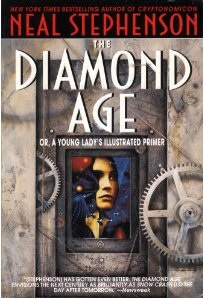
Book Review: The Diamond Age

Neal Stephenson
1995
Awards: Hugo
Rating: ★ ★ ★ ★ ★

Neal Stephenson is one of my favorite sci-fi writers and I’m disappointed that with all the funny, rich, and prescient books he has written, I only get to write about one of them here.

I was introduced to Stephenson by a co-worker who suggested that I start with this book rather than the somewhat more famous Snow Crash. About ten pages in, I was hooked.

The opening chapter drops you bang into a new world on the outskirts of Shanghai fifty years or so in the future. You don’t understand any of the lingo or the technology or much of what is going on at first. But (as in Neuromancer, or A Clockwork Orange, or anything by Shakespeare) you learn quickly by immersion.

The society of The Diamond Age is technologically advanced but in many ways socially backward. Almost everybody belongs to a “phyle,” which is a sort of tribe or clan. Phyles are heavily class-segregated; the phyle you are in determines where you live, whether your neighborhood is polluted and crime-filled or not, how much education you receive as a child, and so on.

People who don’t belong to any phyle are called “thetes.” They live in a sort of demilitarized zone between phyle enclaves. They are outcasts who must survive by their wits and often by turning to lives of servitude or crime.

Some phyles have strength because of sheer numbers or sheer ruthlessness. Others have strength because they possess skills that others are willing to pay for. The richest and most powerful of these is the New Atlantis phyle, which is home to nearly all the “artifexes” (designers & programmers) of the nanotechnology that the world depends on. New Atlantis enclaves are on artificially extruded hills high above the poorer sea-level phyles, where the air is cleaner and their houses are easier to defend.

New Atlantans have adopted the lifestyle and mores of late-19th century Victorians – deeply repressed emotions; convoluted social etiquette; sweeping skirts and parasols for women; snuffboxes and waistcoats for men. But all of these affectations are supported by, and in some cases overtly combined with, the incredibly advanced nanotechnology that pervades everything.

Nanosites are responsible for purifying water and air and for performing most medicine. Neighborhoods are protected by grids of hovering nano-pods that can either be passive information-gatherers or defensive weapons. And the coolest thing (I thought at the time I read it) is that newspapers and books are no longer made of paper and print; they are now made of nano-paper, thin layers of nanosites sandwiched between mediatronic screens that can display a universe full of multimedia presentations at the request of the reader. (And to think it only took Apple 15 years after this book came out to come up with the iPad.)

To try to sum up the plot quickly (a tremendous injustice):

Lord Alexander Chung-Sik Finkel-McGraw, a powerful man in New Atlantis, sees that the crushing overprotectivity of his clan is causing their children to grow up without either creativity or common sense, and that this will eventually lead to their downfall. He hires a brilliant artifex, John Percival Hackworth, to build an intelligent, interactive book, a book he calls the Young Lady’s Illustrated Primer, for his granddaughter. The book will supplement and subvert the Victorian educational system; it is designed to teach a child to think creatively and to solve real problems, instead of the theoretical ones presented in schools.

Finkel-McGraw contracts with Hackworth to build one book, under top secret conditions, and makes him swear to destroy the compiled code so no one can ever build another one.

Hackworth builds the book but does not, however, destroy the code. He sneaks it out of his laboratory and takes it to a seedy neighborhood in Shanghai where he pays Dr. X, an off-network power broker with a matter compiler, to compile a second copy for his own daughter.

From here on in, of course, the gig is up. Not only does Dr. X immediately start trying to decrypt the compiler code so he can build his own copies of the book, but also, on his way back to New Atlantis, Hackworth is mugged by a gang of thete youths who rob him of everything he has, including the book. One of the thetes takes the book home and gives it as a present to his four-year-old sister, Nell.

Nell and her brother live in poverty, holed up in an apartment with a mother who entertains a steady stream of boyfriends, many of whom are abusive. They get most of their food from the free public matter compilers. Nell’s brother has steadily worsening asthma from the pollution in their neighborhood. Neither Nell nor her brother goes to school. But Nell immediately takes to the book, and the book, as it was programmed to do, bonds with her. It builds its lessons around her real life, including teaching her weaponry and self-defense. Eventually, following the arrival of a particularly violent boyfriend and with the help and advice of the book, Nell and her brother run away.

Tension builds as Nell spends the next few years evading capture by various people who want her book. Dr. X starts creating hundreds of thousands of copies of the Primer to give to orphans in China. Several phyles with terrorist bents, including one particularly scary one called the Fists of Righteous Harmony, grow stronger and begin to endanger the safety of the formerly protected ones. Eventually it starts to look like Nell, with her book-raised intelligence, pragmatism, and reluctant leadership skills, will be the one the world will depend on to take it in a new and better direction.

The style and content of The Diamond Age make you think right away of Neuromancer. While I liked Neuromancer okay, I never found myself laughing out loud while reading it like I do with Stephenson’s books. He’s got a sarcasm to him that is really funny.

Also, there’s something about the characters and the environment here that is more appealing to me. Some people have called Stephenson’s writing “post-cyberpunk,” to differentiate it from Gibson, the main idea being that in Gibson's original cyberpunk fiction the heroes are criminals bridling against a repressive dystopia, while the heroine in this one is definitely not a criminal and the world is not under any one omnipotent entity’s control.

The technology in The Diamond Age is just futuristic enough to be cool and amazing, but it is also described realistically enough that it seems like it could conceivably be developed by humans without aid of magic. It isn’t jarringly juvenile and is clearly thought up by somebody who knows about computers. It is also a great combination of old and new; for example, the New Atlantans want to ride around on horses like real Victorians, but they demand robotic horses that can take them at car-like speeds and do their own navigation.

Also, the Primer itself, as a storybook within a story, was brilliant. One of the best fairy tales Nell reads in her Primer takes place in the Dukedom of Turing, which is populated by robotic knights who throw her character into a dungeon. She has to figure out how to escape and then how to gain mastery over all of the robot knights, and along the way you (and she) see that the fable is teaching her the basics of computers and binary numbering systems and how to debug and reprogram code to do what you want it to do. It is awesome.
Related Posts with Thumbnails