There's plenty to criticize in the Simpson-Bowles and Rivlin-Domenici deficit reduction proposals that have been offered in the last week. Our number-one problem right now is punishingly high unemployment, not the projected deficit in 2030. Also, our long-term fiscal problem is almost entirely a health-care story, and neither plan really addresses that.
But punishingly high unemployment is a really hard problem to solve, and health care is even tougher, so instead I'm going to talk – muse, really – about how much I like the fact that both fiscal proposals adopt the technique of "zeroing out" all the various tax deductions and credits that tend to accumulate in the tax code over time, thereby forcing would-be deficit cutters to justify their full cost if they want to add them back in.
The home mortgage-interest deduction is an obvious one. At the margin, it might turn a few renters into homeowners, but the vast bulk of the expenditure goes toward subsidizing larger, costlier homes than people would otherwise purchase. And, like all tax deductions, it is worth more to high-income families, who have bigger interest bills and higher tax rates, than it is to low-income families. Many if not most of those marginal home-buyers pay too little in interest to itemize anyway; they take the standard deduction and derive no benefit from this subsidy.
Then there are the various tax credits for children, for postsecondary education, for storm windows, for electric cars. If we want to subsidize children and education and storm windows and electric cars, we ought to appropriate the funds and send folks a check so they can pay for these items. That's harder to do politically, but it's more honest.
Businesses get special tax breaks on research and development expenditures, and from time to time they also manage to get Congress to pass accelerated depreciation rules, supposedly to encourage the purchase of capital equipment. Both subsidies may well be worthy goals; if so, let's just cut them a check for R&D and for capital equipment. I imagine this sort of thing would be distasteful to rugged-individualist business owners, but we all have to do our part.
In addition to distorting our economic decision-making and letting economic policy-makers off the hook, these tax breaks, deductions, credits, and so on all cost money. That's why analysts call them "tax expenditures." To offset the expenditure, we have to raise the statutory tax rate. It's like when a furniture store raises the retail price of a sofa before announcing a 50% off sale.
The 1986 tax reform, which abolished many tax breaks, including the preferential rate on capital gains, offers a partial guide, and I'm surprised I haven't heard more people citing it. The broader tax base made lower rates possible, though we may have overshot on the rate-cutting. George H.W. Bush and Bill Clinton both had to raise taxes in the early 1990s to deal with burgeoning deficits. Still, "broaden the base and lower the rates" is the right starting point for any reform.
Showing posts with label Taxes. Show all posts
Thursday, November 18, 2010
Tuesday, September 14, 2010
A Couple of Points re Obama’s Tax Proposal
By
C - Log
A couple things that I don't think have been covered sufficiently, either because they're too subtle for the day-to-day news cycle or because Obama has failed to communicate them; probably some of both.
1. The so-called “Bush Tax Cuts,” as enacted, are scheduled to expire on December 31, 2010. That was the law that President Bush pushed for and signed. He may have wanted and expected the tax cuts to be made permanent at some point, but that's really neither here nor there. You don't get credit for good intentions, or you shouldn't, anyway. If people (with incomes less than $250,000) are paying the same marginal tax rate in 2011 that they did in 2010, that's Obama's doing, not Bush’s. I suppose it's too much to request that such a policy be referred to as the “Obama tax cut;” anyway when even Democratic partisans fail to do so it’s probably not gonna happen.
2. The phrase “allow the tax cuts to expire for those making more than $250,000” makes it sound like people with income in that range are going to lose the entirety of their Bush-era tax cuts. Not so! It just means that they’ll no longer pay the lower Bush-era rates on the dollars above $250,000. Dollars 1 through 250,000 will still be taxed at the lower rates, which means that if Obama follows through on his campaign promise, this cohort will still get a substantial tax cut. Smaller than the tax cut that Bush gave them, sure, but larger than the zero tax cut they’d have if Obama does nothing.
1. The so-called “Bush Tax Cuts,” as enacted, are scheduled to expire on December 31, 2010. That was the law that President Bush pushed for and signed. He may have wanted and expected the tax cuts to be made permanent at some point, but that's really neither here nor there. You don't get credit for good intentions, or you shouldn't, anyway. If people (with incomes less than $250,000) are paying the same marginal tax rate in 2011 that they did in 2010, that's Obama's doing, not Bush’s. I suppose it's too much to request that such a policy be referred to as the “Obama tax cut;” anyway when even Democratic partisans fail to do so it’s probably not gonna happen.
2. The phrase “allow the tax cuts to expire for those making more than $250,000” makes it sound like people with income in that range are going to lose the entirety of their Bush-era tax cuts. Not so! It just means that they’ll no longer pay the lower Bush-era rates on the dollars above $250,000. Dollars 1 through 250,000 will still be taxed at the lower rates, which means that if Obama follows through on his campaign promise, this cohort will still get a substantial tax cut. Smaller than the tax cut that Bush gave them, sure, but larger than the zero tax cut they’d have if Obama does nothing.
Saturday, February 13, 2010
The Robin Hood Tax
By
C - Log
The fact that it features Bill Nighy (definitely Netflix the original UK miniseries "State of Play
"-- forget the pale US theatrical release
) is just one of dozens of reasons why this video is awesome.
For an economic analysis of how a 0.5% financial transaction tax in the U.S. could raise $100 billion per year, (even assuming reductions in trading activity due to the tax) while also curbing speculation, check out this briefing paper from the Center for Economic and Policy Research:
PDF
| Flash
For an economic analysis of how a 0.5% financial transaction tax in the U.S. could raise $100 billion per year, (even assuming reductions in trading activity due to the tax) while also curbing speculation, check out this briefing paper from the Center for Economic and Policy Research:
Topics:
Economic Policy,
Movie Reviews,
Taxes,
TV Reviews
Wednesday, January 27, 2010
Oregonians Decide that the Wealthy and Corporations Should Contribute More in Taxes
By
C - Log
Some frankly amazing, to me anyway*, news out of Oregon on Tuesday. The Oregonian reports:
This is a welcome bit of clarity out of the Beaver State after the muddled message of last week's Senate election in Massachusetts. Measures 66 and 67 will reduce the regressive nature of Oregon's state tax system (PDF), in which the poorest 20% of Oregon families, those making under $18,000 a year, pay 8.7% of their income in state and local taxes, while the top 1% of families, those making more than $417,000 a year, pay a state and local tax rate of 6.2%.It looks like Oregon corporations and high-income earners will pay higher state taxes as voters weighed in Tuesday on two hotly debated measures. [...]
Measure 66 raises the income tax paid by households earning at or above $250,000 a year or individual filers who make $125,000 or more. Measure 67 raises the state's $10 minimum corporate income tax.
Together they generate an estimated $727 million, which has already been budgeted by the 2009 Legislature for public schools and other state services.
The tax measures were strongly supported by the state's teachers and other public employee unions. They argued that schools and public services would face damaging cuts.
A coalition of Oregon businesses, including the state's grocers, mounted a campaign to defeat the taxes, arguing that they would cost jobs at a time when the economy is already struggling.
Unemployment in Oregon peaked at a crippling 12.2 % back in May 2009 but has since fallen back to a still-completely-unacceptable 11%. Without this rebalancing of the state tax code, that unemployment rate would likely have gone higher as state and local governments shut down services and shed employees.
Raising income taxes on the wealthy — instead of relying on the usual solutions of lotteries, casinos, or sales-tax hikes —is the fairest, most effective way to raise revenue while protecting jobs and vital public services like schools and health care. The political default position is always against higher taxes (after all, no one wants to pay higher taxes, other things being equal). It is never an easy matter to rebalance a tax code, even in good times. For progressives around the country facing state budget shortfalls and cuts in vital public services, the Oregon story ought to be investigated and the relevant lessons learned.
Thanks to YW Chong for the pointer.
UPDATE: The Oregonian, in a later dispatch, reports that the final margin of victory was big, 54 - 46. Also remarkable is that this is the first voter-approved statewide income tax increase in Oregon since the 1930s.
*I am not always the best guide to what is actually amazing.
Image by vcs.student. Used under a Creative Commons license.
Thursday, July 31, 2008
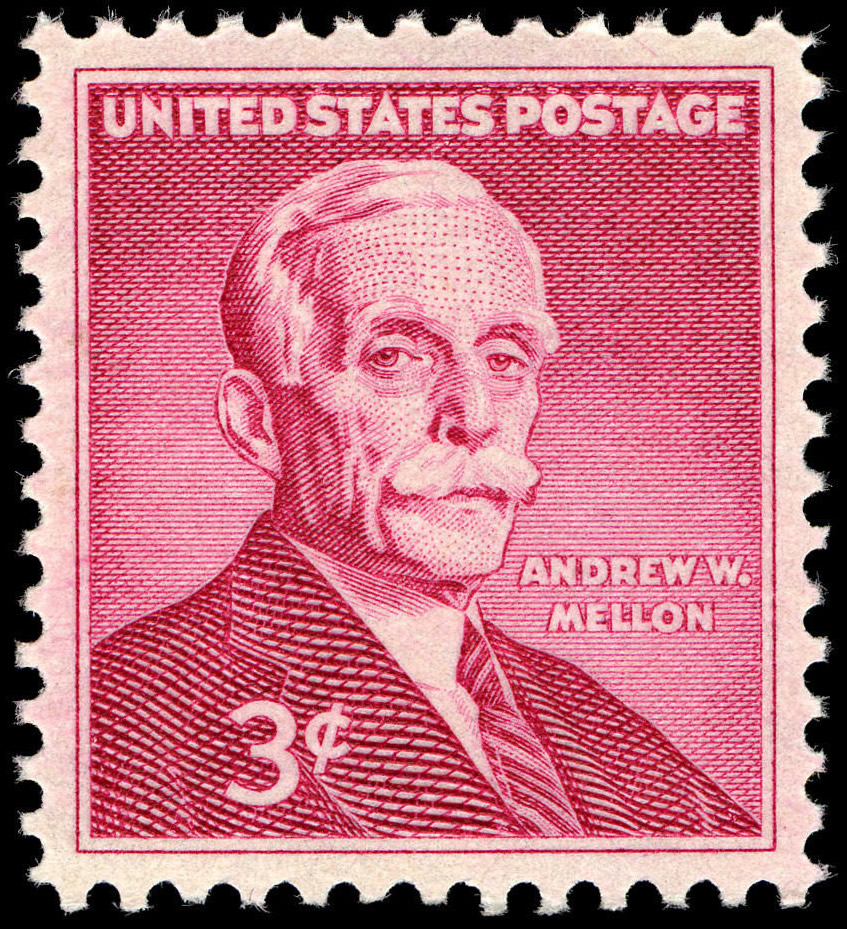
Andrew Mellon: Friend of Tax Fairness
By
C - Log
In his 1924 classic Taxation: The People's Business, Treasury Secretary Andrew Mellon wrote:
“The history of taxation shows that taxes which are inherently excessive are not paid. The high rates inevitably put pressure upon the taxpayer to withdraw his capital from productive business."Key words here: inherently excessive. That's obviously in the eye of the beholder.
But he also wrote:
“The fairness of taxing more lightly income from wages, salaries or from investments is beyond question. In the first case, the income is uncertain and limited in duration; sickness or death destroys it and old age diminishes it; in the other, the source of income continues; the income may be disposed of during a man’s life and it descends to his heirs. Surely we can afford to make a distinction between the people whose only capital is their mettle and physical energy and the people whose income is derived from investments. Such a distinction would mean much to millions of American workers and would be an added inspiration to the man who must provide a competence during his few productive years to care for himself and his family when his earnings capacity is at an end.”So explain to me and Andy again why we tax capital gains and "carried interest" at 15% while nurses and office managers are taxed at a marginal federal rate of 43% (28% + 15.3% FICA tax)?
Is it that now that we have Social Security for workers, we need to give owners a little Investor Security as well, or what?
Friday, July 18, 2008
Marginal Tax Rates
By
C - Log
Following up on "Alex's" comment on the results of my cleaning study, let's turn now to the real Laffer Curve, which holds that there is a theoretical optimum marginal tax rate (if by optimum you mean revenue-maximizing). Too low, and you give up tax revenue that people would otherwise be willing (if not necessarily happy) to pay; too high, and people theoretically would slow down or stop working or investing, so there is less money made and taxed.
Certainly at 100% tax rate there would be no point in working, unless sustenance was provided by the state. For all but the most patriotic people, however, this amounts to slave labor, and such a regime would tend to be violently coercive.
Rather than get into trying to figure out what the optimum marginal tax rate is, I want to focus on an oft-repeated line from billionaire investor Warren Buffett. Here he is in a recent interview with Tom Brokaw:
As for "working," I wonder: Has there really never been someone who took a look at the tax rate and decided it wasn't worth it to work an extra hour? Probably not, especially recently, with the top marginal tax rates at historically low levels, particularly on income from capital. But, it would only take one tax-deterred worker to falsify Buffett's claim, at least if we take the guy's word for it that he stopped working because of high taxes and for no other reason.
On the other hand, it would also be easy for someone to blame the tax system for making him stop working when he was actually just bored or lazy.
Certainly at 100% tax rate there would be no point in working, unless sustenance was provided by the state. For all but the most patriotic people, however, this amounts to slave labor, and such a regime would tend to be violently coercive.
Rather than get into trying to figure out what the optimum marginal tax rate is, I want to focus on an oft-repeated line from billionaire investor Warren Buffett. Here he is in a recent interview with Tom Brokaw:
Tom, I've been around rich people all my life. And I have seen capital gains taxes close to 40 percent. No one went home at 3 in the afternoon and said, "I've worked enough, and because tax rates are so high, I think I'll-- I'll go to the movies." ... I've been managing capital for 50 years for other people. No one left and said, you know, "This-- the taxation system's too tough. I-- I think I'll just stick it all under my mattress." They can't stick under their mattress. They're going to invest their money regardless.This sounds good, but I wonder if it is really true. First, Buffett is conflating working and investment a little bit here. Certainly there are investments, especially hot-money financial investments (as opposed to cold-money capital investments like building a factory), that are especially sensitive to the tax rate. While Buffett is right that a financier won't stick her money in a mattress, a given tax rate might induce her to keep it in cash equivalents instead of taking a flyer on a new venture. None of this has anything to do with "working."
As for "working," I wonder: Has there really never been someone who took a look at the tax rate and decided it wasn't worth it to work an extra hour? Probably not, especially recently, with the top marginal tax rates at historically low levels, particularly on income from capital. But, it would only take one tax-deterred worker to falsify Buffett's claim, at least if we take the guy's word for it that he stopped working because of high taxes and for no other reason.
On the other hand, it would also be easy for someone to blame the tax system for making him stop working when he was actually just bored or lazy.
Wednesday, March 21, 2007
America Before the Estate Tax
By
C - Log
Back in early 2001, at my last job, I had kind of a loopy advertising concept to defend the estate tax against abolition: images of sooty, child-labor-y America around the turn of the 20th century arrayed beneath the headline "What Was America Like Before the Estate Tax?" (The estate tax was first enacted in 1916). It was too over-the-top for the people in charge of the pro-estate-tax campaign, and became kind of a running joke at my expense, but now there is a website full of these images.
It's easy to imagine that life would be just ducky if we just got rid of taxes and regulations and ran a laissez-faire economy, but we tried that already, and I don't think most of us would really like to go back to those days.
(Via BoingBoing)
It's easy to imagine that life would be just ducky if we just got rid of taxes and regulations and ran a laissez-faire economy, but we tried that already, and I don't think most of us would really like to go back to those days.
(Via BoingBoing)
Topics:
Taxes,
U.S. History
Friday, July 22, 2005
The Estate Tax is Dead. Long Live the Estate Tax.
By
C - Log
Sharon Spillane at the indispensable Center on Budget and Policy Priorities writes:
Some Senate Republicans have indicated that a vote on repeal of the estate tax may take place next week, before the start of the August recess. . .The estate tax is probably our fairest tax, as it is paid by those most able to pay: dead multi-millionaires. Whole books have been filled debunking the lies peddled about the estate tax by its selfish opponents. CBPP has all the research you could want on the estate tax, and United for a Fair Economy is doing all it can to preserve it.
In a recent study, the Center on Budget and Policy Priorities estimated that the revenue loss associated with extending estate tax repeal for ten years (2012 through 2021) would total about $745 billion; the cost rises to nearly $1 trillion over that decade when the increased interest costs on the debt are included. . .
Senator Kyl's compromise proposal is tantamount to total repeal . . . It would preserve only 7 percent of the revenue that would be lost under repeal.
If a vote on estate tax repeal or reform comes up in the Senate next week, it will be a test of Senators' commitment to fiscal discipline as well as a demonstration of their priorities.
Subscribe to:
Posts (Atom)