Friday, October 14, 2011

Book Review: The Moon Is a Harsh Mistress

Robert A. Heinlein
1966
Awards: Hugo
Rating: ★ ★ ★ – –

Normally I can't stand Heinlein and his misogynistic Ayn Randian treatises. But this novel was one of his least bothersome (second only in least-bothersome-ness to Starship Troopers).

Basically, if you are able to ignore any references of any kind to women or economic theory, you’ll be able to enjoy the solid science fiction story that makes up the bulk of this book.

The Moon Is a Harsh Mistress takes place, naturally, on Earth’s moon. It is the 2070s and there are large settlements on the moon, or “Luna.” Luna is primarily a penal colony – like Australia was in the early 19th century – and most of Luna’s residents are either convicts or descendants of convicts who were exiled there. Many are serving out additional sentences working as indentured servants for the tyrannical Earth-based Authority corporation.

The moon’s population is an incredibly diverse mixture of races, cultures, and languages; the only thing that all “Loonies” all have in common is a fierce resentment of Authority and the Terran domination it represents. Mistress is about how the people of Luna find their legs and their voice, join together in solidarity to fight for their independence from Earth, and form a new society once they have their freedom - ta da!

The book’s main character, Manuel (“Manny”) O’Kelly Davis, is a multi-racial, multi-lingual, highly skilled technical fix-it freedman with one arm. The entire book is told from his point of view (and, entertainingly, in his strong Russian accent).

The story starts when Manny is called in to fix a glitch in one of Authority’s central computers. During the fix, he discovers that the computer is self-aware and the glitch was a joke, a product of the computer’s malicious sense of humor. Manny names the computer Mike (after Mycroft Holmes, Sherlock’s brother) and the two of them become fast friends.

Initially, Manny has no interest in organized rebellion and is caught up in the Free Luna movement almost by accident, by attending one little meeting that gets raided by police. But his technical abilities and the advantages he gets from his relationship with Mike, who controls the entire network of Authority computers on Luna, propel Manny rapidly right into the center of the struggle and, eventually, the war.

The war for independence puts our hero on an interesting ethical standing. It is, in some ways, an indigenous, grassroots rebellion, but mostly it is carefully orchestrated by Manny, Mike, and a small circle of their closest friends. They provoke Terra into attacking first so they can look like justified martyrs, they fix elections, and they use censorship, semi-truthful propaganda, and harassment (or terrorism) to accomplish their goal of a free Luna.

This book was a tricky one for me to evaluate. It has a large dose of the two elements I can’t stand – and I mean really can’t stand – about Heinlein.

One of these is his awful sexism. Heinlein’s occasional claims of “respect” for women only make him look worse; he is the classic example of a man who puts women up on a pedestal so he can look up their skirts.

The other is his inescapable, simplistic, and pompous Randian economic and social philosophizing. You can never get too far in a Heinlein book before some character goes off on a smug anti-taxation rant.

But, on the other hand, Manny Davis is one of Heinlein’s more appealing characters. He is pragmatic and practical and doesn’t have time for a lot of unrealistic idealism and messing around.

And the moon of Mistress is a darned gritty and satisfyingly realistic setting. Heinlein surrounds his characters with believable underground living quarters and work environments; sensible pressure suits and other equipment; rich family histories and appropriate social structures; and a rich Loonie pidgin. It is easy to picture it as a real, functioning lunar colony.

Friday, September 30, 2011

Book Review: The Falling Woman

Pat Murphy
1986
Awards: Nebula
Rating: ★ ★ – – –

The Falling Woman is set in Dzibilchaltún, a Mayan archeological site near Mérida, Mexico. The main character is an archeologist, Elizabeth Butler, who can see the ghosts of the ancient Maya working and playing around her - often more realistically than she can see her own live workmen and graduate students.

Butler’s long-estranged daughter, who is going through a sort of a lost period following the death of her father, comes to see her and stays to work on the dig. Both mother and daughter then start to see the ghost of a formidable Mayan priestess who can see them too – and who has unpleasant designs on both of them, including wanting Butler to murder her daughter.

The book is clearly and straightforwardly written, the plot is decently exciting and well paced, and the subject matter certainly has potential. My major gripe with it was that there were so many, many details about both the Maya and the field work that didn’t sit right with me. And when I consulted with some Mesoamerican archeologists of my acquaintance, they confirmed that most of these details were either goofy or just plain wrong.

The first thing that jarred me out of the story’s dreamland ghost story vibe was when Butler, the head of the dig, actually puts her cigarette out on the wall of one of the site’s stone temples. Not only would a burning cigarette accelerate the disintegration of an irreplaceable artifact thousands of years old, but it would, as my experts pointed out, contaminate her charcoal and radiocarbon samples.

One of the other archeologists on Butler's crew is described as having a habit of putting any piece of pottery he finds into his mouth, straight out of the ground, and cleaning it off with his spit on the spot. My experts confirmed that you should use water; no one uses (acidic and damaging) saliva because it's acidic and damaging. Also, it's gross.

One of Butler's graduate students explains that the best times to survey are at dawn and dusk, because you are better able to see regular lines and lumps in the ground that might signal human construction. My experts say: “Completely silly. Silly to the max.”

At one point, the archeologists in the book talk about there having been trade between Teotihuacán (in Mexico) and Guatemala, as evidenced by the fact that Teotihuacán pottery has been found in Guatemala. I had been taught by Jared Diamond’s Guns, Germs, and Steel to be wary of a lot of north-south trade in the Americas, so I questioned that as well. My experts said that, yes, there was indeed trade all over Mesoamerica. So some pottery from Teotihuacán did make its way to Guatemala. But it is not clear whether it was direct face-to-face trade or passed gradually from one group to another. In addition, most of the Teotihuacán-style pots in Guatemala are actually locally-made imitations.

And finally (or finally for what I have the patience to write here), the central plot of the book rests on the assumption that the Mayans performed human sacrifices, in the form of throwing people into the cenotes (sacred wells). My experts say that this idea is based on a story that was published at the beginning of the 20th century, itself based primarily on one statement made by a 16th century Spanish explorer.

I think the problem here was that the book purported to present a realistic portrayal of an archeological dig (aside from the ghosts), but that the inaccuracies poked too many holes in that realism and it thus fell apart.

I wanted to get into it. I really did. And I might have been able to if it had been a little less serious about itself. I am willing to overlook a lot of flaws and suspend quite a hefty chunk of disbelief for the sake of a good story - as long as the story isn't pretending to be any more expert than it is.

Take Raiders of the Lost Ark as the best possible counter-example.

Here you have a guy whose primary tools, rather than a Marshalltown trowel and a whisk broom, are a .45 revolver and a bullwhip. He spends far more time punching out Nazis and romancing his lady friend than carefully sifting through ancient trash piles. It is a completely unrealistic portrayal of archeological field work, but an absolutely classic adventure, and doesn't pretend to be anything but.

One of my expert archeologists cited above is actually also one of the world's biggest fans of Raiders. We saw it together in the theater when it first came out; I remember hearing him laugh uproariously when Indiana Jones’s workmen are digging for the entrance to the Well of Souls with giant artifact-destroying shovels, and they hit the roof door with a huge thunk, ripping off a piece of the ancient wood.

He went out and bought a fedora the next day.

Tuesday, September 20, 2011

Obama’s Deficit Reduction Plan: Phase II of a High-Risk but Coherent Strategy

I happened to catch the PBS NewsHour last night for the last part of this segment on Obama's deficit reduction plan. The sound happened to be down on the TV at the time. Even so, I could tell just by looking at the posture and facial expression of the liberal guest, Robert Greenstein of the Center on Budget and Policy Priorities, that he was jubilant. He looked like a cat with a bird in his mouth, feathers floating etc:


Philip Swagel
Maybe that was because his conservative opponent was Philip Swagel, a former Assistant Treasury Secretary in the George W. Bush administration, now a visiting fellow at the American Enterprise Institute on a break from his job as an economics professor at the University of Maryland. I had never heard of him in my life; in fact I thought at first that it was Rich Lowry from National Review. That told me a lot as well: The conservative heavy hitters were apparently unavailable to come on the NewsHour to try to argue against the Buffett Rule and so forth.

Rich Lowry
Greenstein is, for my money, the most credible liberal fiscal-policy analyst in D.C. And the guy could barely contain himself with glee. I remember last December when he gave his qualified blessing to Obama's post-midterm-election deal with the House GOP to trade forbearance on raising tax rates on the wealthy for an extension of unemployment benefits and a payroll tax cut. I tweeted the CBPP analysis and linked to it on Facebook, and was obliquely accused by various observers of "cherry-picking" CBPP charts (whatever that means) in order to put a too-sunny face on a bad deal.

But the CBPP seal of approval was really significant to me back in the bleak days of December 2010. Greenstein has a deep understanding of what's politically achievable, he's very well plugged-in to House and Senate Democratic members, leaders, and staff. He's not as flashy as Paul Krugman or Robert Kuttner, but he's done a heck of a lot more than either of them over the last 20 years to get the best possible legislative deals for liberals (which have admittedly been pretty bad deals as pieces of liberal legislation; my point is that K+K are excellent policy analysts but not at all credible as political tacticians).

So as a hopeless Obamaphile, I was sort of jubilant last night too. Because I see Obama's deficit-reduction plan as the execution of Phase II of a high-risk but nevertheless coherent political strategy:

Phase I
  1. Realize that as a Black man, he is constrained in his ability to mount a full-throated "angry," "confrontational" opposition to GOP tactics, many of which ("You lie!" the birth-certificate nonsense etc.) were clearly designed to bait him into a furious response. If you watched the NewsHour video above, you heard Swagel try several times to call Obama "angry."
  2. Wait until the GOP exposes themselves by taking a one-way trip to fiscal-policy crazy town with, for example, the Ryan plan to voucherize Medicare and the debt-ceiling shenanigans, not to mention Rick Perry's statements that "Social Security is a Ponzi scheme" and a "monstrous lie."
Phase II
  1. Unveil a tough and politically powerful deficit reduction plan that places stark choices before voters: Preserve the New Deal largely intact OR keep taxes on hedge fund managers et al. at rates half of what their secretaries pay. But not both.
  2. It wouldn't hurt if this unveiling took place in mid-September, after the August vacation and town-hall season had ended.
Will Phase II of Obama's plan work? Maybe not. But for a conciliator-type president who had a filibuster-proof Congressional majority for less than one year, it was a coherent plan. And he deserves the support of liberals for executing it.

Monday, September 19, 2011

Journey: Separate Ways (Worlds Apart)


Top 10 features:

10. Air guitar.
9. Drum kit made out of oil drums w/ hi-hat made out of old hubcaps.
8. Black and pink muscle-tee.
7. Excellent Steadicam tracking through pallet-storage areas.
6. Air drumming.
5. Those snug Levi 501's.
4. Bergmanian profile-n-face shots.
3. Popped collar on the tweed jacket.
2. Poignant commentary on U.S. de-industrialization during the 1980s: Disused export dock, forklifts, etc. are repurposed for new top U.S. export: culture.
1. Air keyboards.

Friday, September 16, 2011

Book Review: Mirror Dance

Lois McMaster Bujold
1994
Awards: Hugo
Rating: ★ ★ – – –

Once again I am forced by Hugo voters back into Lois McMaster Bujold’s Vorkosigan Saga.

In general, the Saga is pretty tedious. This installment is basically par for the course but it does have one fairly significant plus, in that it involves one of my favorite sci-fi subgenres: the production of laboratory-raised clones to use as organ donors or body vessels to prolong the life of the original gene donor. (See also: Parts: The Clonus Horror.)

The Saga is a series of at least eleven books about a set of planets interconnected by trade and blood relations. Space travel and warfare are at a Star-Trek-level of speed and sophistication. All of the planets have elaborate internecine political struggles and many are ruled by royal houses.

With a couple exceptions, the books tell the life story of Miles Naismith Vorkosigan, the son of the plucky, beautiful starship captain Cordelia Naismith and the handsome, strong, passionate, wise, but reluctantly-ruling Count Aral Vorkosigan of the planet Barrayar. Enemies of the Count attacked Cordelia with biological weapons when she was pregnant so Miles came out stunted and weak, having to spend much of his first years in an incubator and then in various types of therapy.

In spite of his physical disadvantages, Miles of course grew up to be fantastically intelligent, an excellent military tactician, a beloved leader, and irresistibly attractive to both ladies and hermaphrodites. He lives a double life as the dutiful son and heir of the Count on Barrayar and the brilliant, daring Admiral Naismith of Barrayan Imperial Security.

Earlier in the Saga, an evil group of the Count’s enemies stole some of Miles’s cells and brought them back to a sinister lab that raises clones and performs brain transplants on them when the progenitor grows aged and wants a new, younger body. They created a clone of Miles, which they named Mark. Mark has been trained from the incubator to be an assassin, the idea being that they will eventually substitute him for Miles and he will get close enough to kill the Count.

However, by the time of Mirror Dance, the abusiveness of the fiends who raised him has gone too far for Mark. He escapes from his clone crèche, steals one of Miles’s ships, and tries to free all the other clones. The plan goes horribly wrong, Miles comes after Mark and rescues him and the other clones but gets shot and left for dead in the process, and then the rest of the book is spent on Miles’s crew and family (including Mark) trying to find him again and destroying the clone-makers’ compound if they can as well as a nice side benefit.

I’m sure if you’re a fan of the Vorkosigan saga, you will love this book. For me, the whole saga is too much like a romance novel or a soap opera to get very deeply into. (Luckily by the time I reached page 269, or 269/560th of the way through the book, Frederick Pohl’s Man Plus arrived for me at my local library branch so I could take a break for a while.)

Bujold's characters are divided cleanly between those who are unjust and evil and horrifyingly ruthless, and those who are completely in love with Miles. Miles always knows exactly the right thing to do in any social, diplomatic, or wartime situation. As Admiral Naismith he is theoretically in danger of his life almost every minute, but you also never for a moment forget that he’s secretly royal and that gives him a lot of advantages in staff and equipment that others would not have. Also it lets him bestow lavish and perfect but anonymous gifts on his friends and loyal subordinates.

There is a lot of time spent on how tedious and wasteful all the glamorous royal ceremonies are, and the primary characters spend a lot of time being forced to go and dress in fancy uniforms and stand around making cynical comments about the other guests, but underneath it all you feel like they really love it. Who could force the Count and Countess to hold their own Winterfair ball, anyway?

Get ready, because we’re going to have one more round of this with the Hugo-winning Vor Game. Once more into the breach, dear friends, once more.

Friday, September 09, 2011

Another Albers Rug: Play of Squares

Another knitted & felted rug I made based on a design by Bauhaus fiber artist Anni Albers. This one is based on Play of Squares.

Pattern available here.


Wednesday, September 07, 2011

Propaganda

For most of my working life I've made a living as a propagandist. Propaganda is a delightful word to say out loud. It is also a scary word. It conjures images of Goebbels and Big Brother.

Another word for propaganda is advertising, also now something of a pejorative. Persuasive communication is yet another synonym. It is safe, and leaden.

Propaganda per se is morally neutral. It is based on the Latin verb propagare, which means “to propagate,” as when a horticulturalist plants or grafts a cutting. I know this fact about propaganda, and yet I have always struggled with the moral ramifications of creating it. Should not facts and logic be sufficient to win an argument or motivate action? It always was for me, or so I tell myself.

A BoingBoing guest post by Stephen Worth in January 2010 praises passion as a necessary complement to reason. In particular:
The problem with this world isn’t that there isn’t enough logic. The problem is that there isn’t enough compassion. Logic won’t cut it alone in each of our own lives either. There are a million things that make sense to do. I have a whole laundry list full of logical things to do in my own life—more than I'll ever get around to doing. Guess which ones I actually go out and do? Reason may be the reason to do things, but passion is what makes things actually happen.
Worth is right. Logic may appear to offer safe harbor for those of us who want to escape the moral dilemmas inherent in persuading people to think or do something. But logic can take you only so far in changing people’s minds (apparently not very far). This has been a very hard lesson for me to learn, and I have to continually re-learn it, which is frustrating because in other areas of my life I am not so thick-skulled. But to make history, you have to temper reason with passion. Scary.

Tuesday, September 06, 2011

Election 2012: 1860 Redux?

With Rick Perry now in the race and doing well, Michele Bachmann’s in trouble out in Iowa. A key staffer is leaving. I still can’t believe that all the Rockefeller Republicans I went to college with are going to stand for this Tea Party takeover. On the other hand, they do have a friend in Obama. As Matt Yglesias tweeted last week, Mitt Romney ought to run for the Democratic nomination.

I don't remember Bachmann making any big mistakes; she impressed me as a campaigner. I think Americans still have serious hangups about women in leadership positions. With time, we’ll get over this, thankfully.

Betty Draper
CTHULHU-INFLUENCED “GENERATIONS” DIGRESSION ALERT: There are so many older silent-generation (b. 1925-42) GOP women who would never vote for a woman for president. (This is the generation of women who were too young to have their value affirmed by the WW II effort and too old to join the 2nd-wave feminists—think Betty Draper in Mad Men.) This entire generation, both genders, is just plain confused about everything (generalizing here), and they’re not sure how to feel about women in power. This generation is also a key part of the GOP coalition. (Did you know that the Silents failed to elect a president? Mondale, Dukakis, and McCain were the only ones to even get nominated.)

How about this: a real 1860 four-candidate barn-burner: Perry wins GOP nomination, Romney starts new Prosperity Party, Obama wins Democratic nomination, and somebody runs to Obama’s left in a Progressive Party. It would have to be an old baby-boomer type, maybe Bernie Sanders (let me know if you can think of a better one...Tom Hayden?) The idea here would be to force through the generational transition of leadership from the Baby Boomers to Gen Xers. Obama’s an Xer; Romney's a boomer but he presents as a modern technocrat. Perry and Sanders will run the Baby Boomers’ last-hurrah campaigns. In this case, I'd say Romney wins, followed by Obama, Perry, and Sanders.

Friday, September 02, 2011

Book Review: The Windup Girl

Paolo Bacigalupi
2009
Awards: Nebula, Hugo
Rating: ★ ★ ★ – –

The Windup Girl takes place in near-future Bangkok after several environmental nightmares have come true. Worldwide oil supplies are completely depleted, so all machines and vehicles are wind, hydrogen, solar, coil-spring, pressure, human, animal, or coal-powered. Global warming has made temperatures soar and sea levels rise dramatically, so Bangkok has to be protected from complete inundation by a system of pumps and levees. And nearly all plants and animals have been wiped out by diseases and have been replaced with genetically engineered variants.

This last is not an accident. Agribusiness corporations deliberately hoarded stores of seeds and then manufactured the diseases, pests, and plagues that wiped out the naturally-occurring plants and animals, so they could profit by selling the starving world their own genetically-modified, disease-resistant, but sterile products. They now basically rule the world economy.

Thailand has held their own against the agribusiness corporations relatively well because they sealed their borders to imports and hired their own secret, illegal “gene-ripper” to develop new, fertile varieties of their own native plants and distribute them on the black market. One of the major agribusiness companies has sent in a secret agent, a “calorie man,” Anderson Lake, to try to discover who the gene hacker is and where his seed bank is stored. Along the way, he meets and (sort of) falls in love with Emiko, a Japanese windup girl – a genetically modified, semi-robotic human conditioned to obey and to serve.

Thailand is ruled nominally by a child queen, and in reality by her regent, the Somdet Chaopraya. Two of her ministries – Trade and Environment – are led by strong, ambitious men who vie against each other to be the next regent. The story is a little confusing and doesn’t really have any one central plot, but essentially what happens is that Emiko and the calorie man get mixed up in the escalating power struggle and eventually serve as catalysts leading to the death of the Somdet Chaopraya and bringing on an all-out civil war.

After I finished this book, I went back and forth for a long time deciding whether I liked it or not. On balance, I decided on a somewhat lukewarm yes.

The near-future Bangkok that Bacigalupi presents is rich and multi-layered and easily pictured. He has unique inventions – the windup girl herself, the calorie men, the genetically engineered animals that populate the city, and the types of energy and propulsion that people have to use in a petroleum-depleted world.

On the other hand, there are a couple major things that are either too disturbing or too annoying to ignore.

First: language. For one thing, this book is written in the present tense, which I’m realizing I generally don’t like in a novel (although I have to admit that it isn’t nearly as annoying here as it is in the Yiddish Policemen’s Union). But the primary irritant in this one is the use of hyperbole.

Everything is described so dramatically. This over-emphasizes the minor events and makes them seem cataclysmic, so that you get desensitized to the drama, and then the parts that really are cataclysmic have less of an impact than they should.

Also, his hyperbolic phrases are pleasing and catchy at first, but after they are used for the fourth or fifth time, they begin to seem formulaic. After a while, I started writing down the particularly obvious repeats:

- Alleys running thick with blood
- Light spearing eyes
- Scalding skin / skin on fire (with heat)
- Ribs exploding with pain / ribs screaming (after beatings)
- Blossoming (e.g. Blood blossoming red after person is shot; a blossom of pain; legs blossoming with hurt)

Second, and more importantly: there are two major rape scenes, both involving Emiko. I’m not sure how to judge the necessity of a graphic rape scene, but these certainly were very disturbing and seemed to go on well past the point where the point was made. I really started to bridle viscerally at how much Bacigalupi felt he had to do to prove how Emiko’s conditioning made her obey even at the cost of her total shame and extreme physical pain.

I did particularly like one of the first scenes in the book, though, where Anderson Lake has to shoot a megodont (a genetically engineered elephant) who has gone rogue in his factory. It reminded me a lot (perhaps intentionally so) of George Orwell’s great essay Shooting an Elephant.

Tuesday, August 30, 2011

Obama’s Economic Policy

Note: this post started out as a comment to a post on the Iowa politics blog Bleeding Heartland. 

Obama’s critics from the left decry his adoption of the GOP frame on deficit reduction. I join them in this critique as a matter of economic policy; the best course right now is larger deficits to stimulate the economy, combined with a longer-term fiscal policy that aims to roughly balance the budget over the course of the business cycle (run surpluses during booms, deficits during during slumps). (Though I would note that as a sovereign issuer of currency the U.S. can comfortably run annual deficits in the 2% to 3% of GDP range indefinitely.)

Still, Obama refuses to follow the standard Keynesian course prescribed by sensible liberals. Why? Why does he adopt the economic policy that he does?

Here are some possibilities that occur to me:
  • He genuinely believes that it is the right thing to do.
  • It is part of a poll-tested strategy to retain enough independent voters in battleground states to enable him to win re-election.
  • He is a blank slate on economic policy and is carrying out the views of various advisers.
  • He is in the sway of shadowy special interests, say key Wall Street figures.
  • He is basing his policies on a different set of data or assumptions than are his critics; in this case, both sides would call the other side "misinformed."
  • He has a deep psychological need to please establishment figures such as the editorial board of the Washington Post, David Brooks, and the rest of what passes for a DC class of opinion leaders.
  • He harbors resentment against liberals and wants to show them who's boss.
  • He knows that government spending in this country is tied up inextricably with issues of race and that as a Black man he cannot activate those latent prejudices among the electorate.
I think the likeliest explanation is the poll-tested strategy one, but I think the race issue has been curiously underplayed. Which ones did I leave out?

Sunday, August 28, 2011

Another Inflation Hawk Argues for a Higher Inflation Target

Economist Kenneth Rogoff, no liberal, is arguing for a higher inflation target:
If the Federal Reserve raises its target inflation rate by several percentage points - up from around 2 percent, where it’s been for the past decade, to somewhere in the neighborhood of 4 to 6 percent - and injects new money into the economy until it gets there, then debtors will get some relief and the wheels of the economy will once again start to turn.
One of the biggest propaganda victories of the 20th century was convincing the middle class that inflation is the worst possible thing that can happen to them. High inflation sucks, to be sure, but people tend to forget that inflation also reduces the real value of one's debts.

We also hear a lot about the "elderly who live on a fixed income." Except that most elderly people depend on Social Security for the bulk of their income, and SS is inflation-protected via COLAs.

However, there is one class of people for whom inflation is in every and all cases an unmitigated disaster: bondholders, a.k.a. the owning class. These are the folks who make money from money. As Rogoff, an inflation hawk, notes, tolerating higher inflation will result in a transfer of income from financiers to workers, (or as he puts it in less class-war terms: from creditors to debtors). That's exactly right. All economic policy is a question of the distribution of income.

Videotaping Cops

The Globe reports:
A court ruled Friday that the 2007 arrest of a Boston lawyer for recording police officers with his cellphone violated the man’s First and Fourth Amendment rights. The ruling by the US Court of Appeals for the First Circuit in Boston allows Simon Glik to continue his lawsuit against the city and the police officers who arrested him. He was charged with violating a state law that bars audio recordings without the consent of both parties. The court affirmed that Glik’s actions had been legal and denied the officers’ claim that they had “qualified immunity’’ because they were doing their jobs as public officials.
On reddit.com there are periodically posts by cops who invite readers to "Ask Me Anything" (examples here). To a person they say they are fine with being videotaped. If cops are doing their jobs correctly, they need not fear being videotaped.

We give cops an awful lot of power and discretion. In particular, they have a state-sanctioned monopoly on the use of deadly force. In return, it is reasonable that citizens have extra oversight powers over their actions.

Friday, August 26, 2011

What Is Science Fiction?

For the 1976 hardcover first edition of Man Plus by Frederik Pohl, the promotional writing on the front flap of the dust jacket says this:
Man Plus is so superbly well done that it will appeal not only to science fiction fans but to readers of such novels as The Andromeda Strain.
Does that mean The Andromeda Strain is not a science fiction novel?

Friday, August 19, 2011

Topkapi

When I read The Light of Day, by Eric Ambler, I had no idea that it had been made into a movie called Topkapi.

I saw the movie recently on TCM and I have to say that I liked it a lot more than I did the book. It played up the comic aspects of the caper, moved more quickly, and was changed from a first-person tale to a more omniscient point of view.

I guess Hollywood screenwriters know what they are doing.

This movie has several tricky stunts in it that are said to have inspired other filmmakers, including the makers of Mission: Impossible (see this clip). It was also filmed on location in Istanbul, which was gorgeous. The best part of the movie, by far, though, was Peter Ustinov, who plays the hapless, bumbling Arthur Simpson to the absolute hilt. (He won his second Oscar for this role.)

It also stars an enigmatic Melina Mercouri and a handsome but callous Maximilian Schell as the masterminds of the heist.

Friday, August 12, 2011

Book Review: Man Plus

Frederik Pohl
1976
Awards: Nebula
Rating: ★ ★ ★ ★ –

Good story ideas come in all sizes. Some are so big they need to have trilogies (or even ennealogies) written to fully flesh them out. For others, one 200-page book is fine. And others are better off as short stories.

Frederik Pohl seems to have an instinct for writing up his original ideas (or original takes on old ideas) into appropriately sized books. He fully explores his premise but doesn’t beat it to death. This means that his books usually end up being relatively short but efficient Cool Idea Delivery Systems.

I think this is the best book by Pohl that I have read so far. Many people have written stories about the colonization of Mars by humans. Usually the premise is that we will terraform Mars to support human life. In Man Plus, instead, the U.S. has a top-secret project to physically modify a human being – a man named Roger Torraway – so that he can survive on the surface of Mars.

Scientists replace his skin with a super-tough, rhinocerous-like hide that can withstand high solar radiation and temperatures hundreds of degrees below freezing. They replace his lungs and most of his circulatory and digestive systems with machinery so that he needs hardly any oxygen or food. They give him new eyes that can see into the infrared and ultraviolet bands of the spectrum. And they put big solar panels on his back to power the parts of him that are now mechanical.

Naturally, there are forces at work conspiring to make the project difficult. One is internal; Roger’s wife Dorrie is a bit of an unsupportive whiner and is also having an affair with one of the project’s scientists. This is pretty upsetting to Roger, especially at a time when he’s being turned into an unrecognizable monster and preparing to spend two years alone in space.

The other problem is external. According to all the most reliable governmental models, the world will soon descend into nuclear war. The only thing that will turn the projections around, apparently, is a successful manned mission to Mars (to rally and inspire humanity, I presume). The pressure on the Man Plus scientists to succeed in an unrealistically short time is therefore immense, so much so that their only other Mars-altered human subject died in the lab from too much aggressive testing.

It’s a good premise and the story is suspenseful in its own subtle way. You want to find out if Roger can survive all the operations and the mental and physical stress and make it to Mars, and you really want to find out what it’s like through his eyes when he gets there. For most of the book, Pohl keeps dangling the promise of the upcoming mission just out of reach (of both you and Roger) like a tasty carrot.

There is also a quiet, almost incidental mystery running through the book about who the narrator is. Most of the time I forgot to wonder about it, as I was absorbed in the rest of the story, but it does add a nice additional piece of intrigue and allows the book to end with a bit of an extra flourish.

Friday, August 05, 2011

99 Views of Wilco

I've been having a great time going through my pictures of the Solid Sound Festival three weeks ago (June 24-26). And, since I imagine that everybody else can't get enough of my concert photography, here's a collage I put together of of 99 pictures I took at the two Wilco shows.

Actually, to be honest, it's 98 pictures of Wilco and one picture of Pajama Club.

Full-screen downloadable version here: http://www.scribd.com/fullscreen/59408454

Friday, July 29, 2011

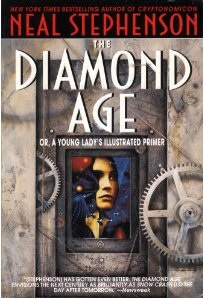
Book Review: The Diamond Age

Neal Stephenson
1995
Awards: Hugo
Rating: ★ ★ ★ ★ ★

Neal Stephenson is one of my favorite sci-fi writers and I’m disappointed that with all the funny, rich, and prescient books he has written, I only get to write about one of them here.

I was introduced to Stephenson by a co-worker who suggested that I start with this book rather than the somewhat more famous Snow Crash. About ten pages in, I was hooked.

The opening chapter drops you bang into a new world on the outskirts of Shanghai fifty years or so in the future. You don’t understand any of the lingo or the technology or much of what is going on at first. But (as in Neuromancer, or A Clockwork Orange, or anything by Shakespeare) you learn quickly by immersion.

The society of The Diamond Age is technologically advanced but in many ways socially backward. Almost everybody belongs to a “phyle,” which is a sort of tribe or clan. Phyles are heavily class-segregated; the phyle you are in determines where you live, whether your neighborhood is polluted and crime-filled or not, how much education you receive as a child, and so on.

People who don’t belong to any phyle are called “thetes.” They live in a sort of demilitarized zone between phyle enclaves. They are outcasts who must survive by their wits and often by turning to lives of servitude or crime.

Some phyles have strength because of sheer numbers or sheer ruthlessness. Others have strength because they possess skills that others are willing to pay for. The richest and most powerful of these is the New Atlantis phyle, which is home to nearly all the “artifexes” (designers & programmers) of the nanotechnology that the world depends on. New Atlantis enclaves are on artificially extruded hills high above the poorer sea-level phyles, where the air is cleaner and their houses are easier to defend.

New Atlantans have adopted the lifestyle and mores of late-19th century Victorians – deeply repressed emotions; convoluted social etiquette; sweeping skirts and parasols for women; snuffboxes and waistcoats for men. But all of these affectations are supported by, and in some cases overtly combined with, the incredibly advanced nanotechnology that pervades everything.

Nanosites are responsible for purifying water and air and for performing most medicine. Neighborhoods are protected by grids of hovering nano-pods that can either be passive information-gatherers or defensive weapons. And the coolest thing (I thought at the time I read it) is that newspapers and books are no longer made of paper and print; they are now made of nano-paper, thin layers of nanosites sandwiched between mediatronic screens that can display a universe full of multimedia presentations at the request of the reader. (And to think it only took Apple 15 years after this book came out to come up with the iPad.)

To try to sum up the plot quickly (a tremendous injustice):

Lord Alexander Chung-Sik Finkel-McGraw, a powerful man in New Atlantis, sees that the crushing overprotectivity of his clan is causing their children to grow up without either creativity or common sense, and that this will eventually lead to their downfall. He hires a brilliant artifex, John Percival Hackworth, to build an intelligent, interactive book, a book he calls the Young Lady’s Illustrated Primer, for his granddaughter. The book will supplement and subvert the Victorian educational system; it is designed to teach a child to think creatively and to solve real problems, instead of the theoretical ones presented in schools.

Finkel-McGraw contracts with Hackworth to build one book, under top secret conditions, and makes him swear to destroy the compiled code so no one can ever build another one.

Hackworth builds the book but does not, however, destroy the code. He sneaks it out of his laboratory and takes it to a seedy neighborhood in Shanghai where he pays Dr. X, an off-network power broker with a matter compiler, to compile a second copy for his own daughter.

From here on in, of course, the gig is up. Not only does Dr. X immediately start trying to decrypt the compiler code so he can build his own copies of the book, but also, on his way back to New Atlantis, Hackworth is mugged by a gang of thete youths who rob him of everything he has, including the book. One of the thetes takes the book home and gives it as a present to his four-year-old sister, Nell.

Nell and her brother live in poverty, holed up in an apartment with a mother who entertains a steady stream of boyfriends, many of whom are abusive. They get most of their food from the free public matter compilers. Nell’s brother has steadily worsening asthma from the pollution in their neighborhood. Neither Nell nor her brother goes to school. But Nell immediately takes to the book, and the book, as it was programmed to do, bonds with her. It builds its lessons around her real life, including teaching her weaponry and self-defense. Eventually, following the arrival of a particularly violent boyfriend and with the help and advice of the book, Nell and her brother run away.

Tension builds as Nell spends the next few years evading capture by various people who want her book. Dr. X starts creating hundreds of thousands of copies of the Primer to give to orphans in China. Several phyles with terrorist bents, including one particularly scary one called the Fists of Righteous Harmony, grow stronger and begin to endanger the safety of the formerly protected ones. Eventually it starts to look like Nell, with her book-raised intelligence, pragmatism, and reluctant leadership skills, will be the one the world will depend on to take it in a new and better direction.

The style and content of The Diamond Age make you think right away of Neuromancer. While I liked Neuromancer okay, I never found myself laughing out loud while reading it like I do with Stephenson’s books. He’s got a sarcasm to him that is really funny.

Also, there’s something about the characters and the environment here that is more appealing to me. Some people have called Stephenson’s writing “post-cyberpunk,” to differentiate it from Gibson, the main idea being that in Gibson's original cyberpunk fiction the heroes are criminals bridling against a repressive dystopia, while the heroine in this one is definitely not a criminal and the world is not under any one omnipotent entity’s control.

The technology in The Diamond Age is just futuristic enough to be cool and amazing, but it is also described realistically enough that it seems like it could conceivably be developed by humans without aid of magic. It isn’t jarringly juvenile and is clearly thought up by somebody who knows about computers. It is also a great combination of old and new; for example, the New Atlantans want to ride around on horses like real Victorians, but they demand robotic horses that can take them at car-like speeds and do their own navigation.

Also, the Primer itself, as a storybook within a story, was brilliant. One of the best fairy tales Nell reads in her Primer takes place in the Dukedom of Turing, which is populated by robotic knights who throw her character into a dungeon. She has to figure out how to escape and then how to gain mastery over all of the robot knights, and along the way you (and she) see that the fable is teaching her the basics of computers and binary numbering systems and how to debug and reprogram code to do what you want it to do. It is awesome.

Friday, July 22, 2011

The Paleolithic Diet

Periodically I hear talk about a cure-all eating regime called the “Paleolithic diet.” The idea behind it is that our bodies are adapted best for the diets we ate 30,000 years ago, as opposed to all the processed foods and refined sugars we’re eating now. I like the basic idea, but none of the descriptions I have heard felt truly Paleolithic to me.

After consulting with some anthropologists of my acquaintance, I have come up with what I believe is the true Paleolithic diet, which I present here.

Simply choose one of the following five menus:


No refrigeration is allowed, but you may smoke, dry, salt-cure, or ferment foods to preserve them. Eat meats in bottom section only once every four weeks. When you are in a meat-eating week, eat every edible part of the animal and consume the equivalent of one-quarter to one-half deer within the first three days.

Coming soon: menus for Ngandong & Monte Verde.

Friday, July 15, 2011

It Has All Been Foreseen

Could the current debt ceiling standoff herald a key turning point in American history? Check out this scenario laid out in 1997 by Generations authors William Strauss and Neil Howe:

An impasse over the federal budget reaches a stalemate. The president and Congress both refuse to back down, triggering a near-total government shutdown. The president declares emergency powers. Congress rescinds his authority. Dollar and bond prices plummet. The president threatens to stop Social Security checks. Congress refuses to raise the debt ceiling. Default looms. Wall Street panics.

—Strauss and Howe,  The Fourth Turning
p. 273
Strauss and Howe argue that American history repeats itself on a four-generation cycle, and since the early 1990s they’ve been warning us to expect an historic turning point right around now. They predict a cataclysm on the scale of the American Revolution, the Civil War, and the Great Depression / World War II. They call it the “Fourth Turning.” Depending on who wins the conflict, this crisis and its aftermath will define the course of American history for the next four generations.

Thanks go to Cthulhu, Destroyer of Worlds for staying on top of this.

Friday, July 08, 2011

Book Review: Black Cherry Blues

James Lee Burke
1989
Awards: Edgar
Rating: ★ ★ – – –

This book was well-paced and suspenseful. The core plot was good. It wasn’t cheap or sloppy or half-heartedly put together. Otherwise, however, it was pretty much a disappointment.

The descriptions of Louisiana and Montana landscapes, cuisine, and people seemed self-conscious and smug. So did the main character’s running and weightlifting. Conversations were full of phrases that I think were supposed to be clever but just came out as strange. The treatment of race was weird. And the hero had a streak of violence in him that seriously undercut his indignation about the behavior of others.

The story is about a former cop, Dave Robicheaux, who lives on the Louisiana coast making a modest living running a bait shop and fishing-boat rental business. His inner circle consists of two people who help him out around the shop and his house, and an adopted daughter, Alafair, from El Salvador. He is haunted by dreams of both Vietnam and his dead wife, who was killed by gangsters getting revenge on him for some past escapade.

Aside from the dreams, all is basically well with Robicheaux’s life until he bumps into an old friend: a drug-addicted, down-on-his-luck former rock-and-roll star now working as a leaseman for an oil company. His friend asks him to investigate a conversation that he overheard between two co-workers talking about how they killed a couple guys up in Montana. Before he knows it, Robicheaux is sucked up into a web of danger and intrigue involving mobsters, hired hit men, hot-blooded Salish Indian women, and, of course, winsome elementary school principals who have such incredible generosity they don’t mind that he keeps dumping his kid on them when he needs to go beat up a guy or confront a mobster or otherwise put himself in a life-threatening situation.

In the course of his investigation, Robicheaux has to travel from Louisiana to Montana, giving the author plenty of opportunity to show his intimate knowledge of both (Burke lives in Louisiana and spends a lot of vacation time in Montana). Sometimes an author will bring you into a country with them, sharing it with you, making you feel like you understand it too (as in The Healer’s War, Dance Hall of the Dead, or The Lingala Code). But Burke’s descriptions came off as braggadocio – or as inside jokes I wasn’t privy to. Also, although his writing about scenery is quite detailed, I found it strangely hard to picture.

I had a bit of a hard time with how Burke portrays black people in the book. Robicheaux is white. About the black man and woman who work for him (whose poor grammar he is constantly making fun of), he says: “I was always amazed by the illusion of white supremacy in southern society, since more often than not our homes were dominated and run by people of color.” I think this is supposed to come across as a compliment, or perhaps wryly funny, but, since he shows no real understanding of what his employees are like as people, it comes across as a tad patronizing. When push comes to shove, who’s really in charge of that bait shop? This is also the only time in the book he calls them anything but “Negro.” I might be a prude, but I’m not sure that “Negro” is the absolutely best term for 1989.

Robicheaux is a recovering alcoholic, but I found his recovery very glossy. It felt more like a gimmick than an integral part of his character. He goes through a dry drunk complete with fever and tremors one day and then the next day goes to get an ice cream cone with his daughter like nothing ever happened. He is also very smug about abstinence with his rock-and-roller friend, who still struggles with self-control every day. It is a pale shadow of Lawrence Block’s excellent Matt Scudder novels, another detective series with an alcoholic lead, which, fortunately, I’ll get a chance to rave about another time.

And, finally, Robicheaux is self-righteous and judgmental about the violence of the mobsters he’s investigating, but he himself has horrifyingly violent episodes. At one point, for example, he ambushes two goons who threatened the life of his daughter and spends probably fifteen minutes beating them within an inch of their lives with a five-foot length of chain. This doesn’t fit. If you’re going to be an anti-hero, you can’t go around on the one hand talking like you’re a saint and then on the other hand be eagerly and gratuitously bloody in your revenge. You need to take care of your problems with reluctant but necessary dispatch.

Friday, July 01, 2011

Roger, Wilco

I got no reading done this past weekend. I spent the entire time at the Solid Sound festival in North Adams, MA. This was my first music festival ever and I had a really, really, really, really, really good time. More creative neurons were firing in my brain than had been firing for a very long time.

More power to the members of Wilco for encouraging each other to express themselves independently in so many different ways. My personal highlights:
  • Being right up front for two Wilco concerts on two consecutive days
  • Neil Finn joining the band on stage for an awesome two-fer: Wilco's "I Got You" followed by Split Enz's "I Got You"
  • Vivian Maier photo exhibit curated by Pat Sansone
  • Picturesque de-industrialization-of-America venue at Mass MoCA
  • Falconry
  • Sweet potato fries at the Samosa Man
  • Art & music everywhere
The rain only made it more memorable. I'm only sorry that I missed the handmade music lounge.

Waiting for WILCO
WILCO Sign
Gods-Eyes
Nels's Guitars
Nels Cline
Jeff Tweedy
Pat Sansone
John Stirratt
Cline-Sansone Guitar Battle
WILCO

Friday, June 24, 2011

Book Review: Moving Mars

Greg Bear
1993
Awards: Nebula
Rating: ★ ★ – – –

Moving Mars takes place about 200 years into the settlement of Mars. Earth exploits Mars economically and most Martian settlers bridle at the exploitation. Their active resistance gradually escalates until Earth decides to crack down on them with deadly force. The Martians are backed into a corner, faced with either giving in and giving up their independence, or defending themselves with a super-powerful new technology that will have disastrous consequences for Earth and will change the lives of everyone on Mars as well.

The main character, Casseia Majumdar, is a lowly student protester at the University of Mars at the beginning of the book but eventually winds up as a powerful Martian politician faced with the burden of deciding whether or not to use their new weapon.

I originally read Moving Mars several years ago and liked it. I just read it again recently and I’m no longer so sure.

On the one hand, the story takes place on Mars, is based on a good main premise, and has a strong female protagonist.

On the other hand, Casseia often makes frustrating decisions and seems disingenuously naïve about her influence on others. The book strikes a frustrating middle ground between hard and soft SF: there is too much scientific explanation for inventions to be simply fantastical, but they are too vaguely explained to be believable. And the book introduces lots of different ideas and subplots but doesn’t explore them with any depth.

Example 1: One cool subplot that weaves in and out of the story is that Mars had sophisticated native life forms that went extinct millions of years ago. The book’s characters keep finding their fossils. But, unlike Isaac Asimov’s Nemesis, this is never directly tied into the main plot line and just sort of ends up being an interesting aside that doesn’t go anywhere.

Example 2: Mars’ economy is organized into Binding Multiples, which are not only business conglomerates but also extended families functioning as self-contained, semi-cooperative governments. Residents of Mars are deeply resistant to any attempt to form a Martian state government any more centralized than their existing BMs. But it’s not entirely clear where their passionate and sometimes violent anti-statist fervor comes from, especially when Earth will so clearly be able to crush a divided Mars, when the BMs don’t actually work so well, and when the government they do end up creating is so loosely federated. This is very different from the situation in Robert Heinlein’s The Moon Is a Harsh Mistress, where resistance to centralization makes a lot more sense.

Example 3: Another frustrating sub-plot (or co-main-plot) is Casseia’s on-again, off-again romantic history with Charles Franklin, the chief architect of the super-weapon. Their relationship is never really ended or resolved, even though both of them get married to other people at different points. Charles is drippy, willing to wait his entire life just hoping she’ll come around. And Casseia, who is an able politician and a smart person, seems to be unable to decide what to do about Charles and constantly gives him double messages. She basically only comes to grips with what she wants when it’s too late.

I should make it clear that I am a Greg Bear fan. But I like Bear best when he takes an original, unique idea – of which he has many – and explores it in a more focused way without so many false and unresolved leads. It seems like Moving Mars is trying to do the job of several different books at once and doesn’t quite succeed at any of them.

My recommendation would be that if you want a realistic hard SF story about the colonization of Mars and a deft exploration of the tension with Earth that would naturally result, read Red Mars by Kim Stanley Robinson. If you want a mind-stretching read about enormous planetary-scale engineering projects, read Larry Niven’s Ringworld. And if you want a creepy, page-turning, fun book by Greg Bear, run right out and get Blood Music, a sort of biological version of Cat’s Cradle that, as far as I know, never won any awards.

Wednesday, June 22, 2011

Facial Hair of the Civil War

During the summer of 2008 I engaged in some facial hair tomfoolery, growing full-cheek sideburns connected by a mustache in an attempt to emulate Civil War general Ambrose Burnside (pictured).

The Smithsonian Institution has gathered a collection of Civil War facial hair styles, Burnside's included. Readers are invited to vote for their favorite.


Saturday, June 18, 2011

Friday, June 17, 2011

Book Review: Dance Hall of the Dead

Tony Hillerman
1973
Awards: Edgar
Rating: ★ ★ ★ – –

About fifteen years ago, I read three Tony Hillerman books in a row. I really liked the first, the second a little less, and, by the third, I have to admit I found them getting kind of repetitive.

I’m glad it’s been fifteen years, because reading Dance Hall of the Dead was like reading Hillerman again for the first time. Refreshed.

Hillerman’s novels are set in the Four Corners area of the U.S. where Colorado, Arizona, New Mexico, and Utah all meet. It’s a dusty, desert-y region home to several Indian reservations – Navajo, Zuni, Hopi, and Acoma, among others. It’s also home to archaeological digs and (in the book, at least) a hippie commune.

Dance Hall was one of Hillerman’s earliest novels, and the second to use his really appealing protagonist Joe Leaphorn, a detective with the Navajo police.

Leaphorn is called in to help when a Zuni boy is found murdered and the boy’s best friend, a Navajo, goes missing. Zuni (which Hillerman spells Zuñi) and Navajo people are by no means friendly, usually, but in this case Leaphorn has to cooperate with the Zuni police and work with both Zuni and Navajo witnesses. He learns more about Zuni religion and tradition than he ever wanted to when it really starts to look like the Zuni boy was killed by a kachina – a Zuni ancestor spirit.

This book makes you very conscious of tempo. Joe Leaphorn moves at his own speed. He takes his time watching a location from far away through binoculars before going in to investigate close up. He works his way very slowly around to asking the questions at the core of his investigation. He’s very happy to let many seconds or even minutes pass in silence when he’s talking to someone.

It sometimes seems to be inefficient and slow, but he’s actually getting quite a lot figured out with this technique. So the investigation and the story progress deceptively quickly. And, towards the end, when Leaphorn gets closer and closer to solving the case, the story picks up speed quite smoothly and expertly, so where you originally felt like you were reading a kind of peaceful, slow-moving story, suddenly you find yourself rapidly turning pages and in the midst of quite a lot of suspense and Leaphorn in the midst of real physical danger.

It is really interesting to learn about Zunis through the eyes of a Navajo; partly because it means you end up learning about Navajos too. And Hillerman’s writing is calm and clear, just like his main character’s thinking. It never is self-conscious or gets in the way of the story.

Wednesday, June 15, 2011

A New Blog on a Grave Subject

An old professional compatriot of mine has just started a new blog, called Gravely Speaking. It’s all about “graves, gravestones, and graveyards.” Check it out y’all!


Friday, June 10, 2011

Book Review: The Yiddish Policemen’s Union

Michael Chabon
2007
Awards: Nebula, Hugo
Rating: ★ ★ – – –

The reason this book is considered science fiction – and one of the reasons it probably got so much attention – is because it is set in a provocative alternate history. Aside from that, it is really a murder mystery, and not a very riveting one. And it has one major problem, which I will get into in a minute.

The main character, Meyer Landsman, is a homicide detective. He lives in the Alaskan panhandle, in the district of Sitka, which was granted to Jewish refugees on a 60-year lease following the collapse of the state of Israel shortly after World War II. Ever since they began moving in, there has been a tension between the Jewish settlers and the already-resident Alaskans, both native and white.

When the book opens, it is 2007 and the 60-year settlement lease is due to expire in two months. This means that every Jewish person living in the region will need to either get Alaskan permission to stay or will have to move elsewhere. This weighs over everyone throughout the story, especially Detective Landsman, who has done zero preparation for it.

The mystery begins when a man is found murdered in the same fleabag hotel where Landsman is living. Landsman and his partner spend the book solving the case, along the way coping with sinister and corrupt religious fanatics, asocial chess club members, and a police hierarchy that wants to sweep all outstanding homicides under the rug so they can hand over a clean slate to the incoming Alaskan regime.

Sounds good, right?

The major problem, the downfall from which there is no escape, is the writing. Chabon gets a lot of kudos from reviewers for his “smart,” “inventive,” “funny,” and “sharp” style. But I have to say I found it obnoxious.

I have broken my stylistic complaints into three categories.

Complaint One: Tense


This book is told in the present tense. I always find that hard to get used to. Why do authors do that? Is it supposed to create a special mood or sense of heightened drama?

It doesn’t help that this book is full of flashbacks which are told in the past tense. I found it jarring to be coasting along in a nice past-tense flashback and then slamming back into the disconcertingly present-tense main story line.

Complaint Two: Terms

Chabon uses a lot of slang terms for Jewish people or culture. To use a relatively tame example, the Jewish characters all use the word “yid” a lot when referring to themselves or others. I’m sure that Chabon is trying to reclaim the term, the way other minority groups have reclaimed and co-opted derogatory names for themselves. But I don’t have quite the comfort level I need to have with it to read it without cringing a bit.

Complaint Three: Painfully Forced Cleverness


The writing is amazingly, annoyingly, self-consciously clever. He particularly likes to use deliberately quirky metaphors and similes, which are everywhere.

Occasionally it sort of works…
“Scraps of newsprint, leaves, and dust get up impromptu games of dreydl in the archways of the houses.”

“His thoughts are a tattoo needle inking the spade on an ace. They are a tornado going back and forth over the same damn pancaked trailer.”

The village is “a row of steel roofs along an inlet, houses jumbled like the last ten cans of beans on a grocery shelf before the hurricane hits.”
But most of the time… not so much. If I may give you just a tiny sample.
“His teeth are like the pipes of an organ made of bones. His laugh sounds like a handful of rusty forks and nail heads clattering on the ground.”

“The knot of his gold-and-green rep necktie presses its thumb against his larynx like a scruple pressing against a guilty conscience.”

“An invisible gas clouds his thoughts, exhaust from a bus left parked with its engine running in the middle of his brain.”

“The Sitka Saturday afternoon lies dead as a failed messiah in its winding rag of snow.”

A woman’s snoring “has a double-reeded hum, the bumblebee continuo of Mongolian throat-singing. It has the slow grandeur of a whale’s respiration.”

A motorcycle sounds like “The hacking cough of an old man. A heavy wrench clanging against a cold cement floor. The flatulence of a burst balloon streaking across the living room and knocking over a lamp.”
These are often piled one after the other after the other.

The worst part is that every time I encountered one of these gems, it was so distracting that it completely stopped the flow of my reading. In addition to just marveling at its audacity, I’d often have to interpret what the heck it meant. This made it very, very hard to remember what was going on, which in turn made it almost impossible to maintain interest in the story.

If I may use my own simile, it was like riding in a car where the driver keeps randomly applying the brake and then the gas, brake and gas, brake and gas, until you want to scream.

One recurring pattern was for smells to be described in ultra-witty sets of three:
The saunas smell like “chlorine and armpit and a ripe salt vapor that might on second thought have been the pickle factory on the ground floor.”

A sofa gives off “a strong Sitka odor of mildew, cigarettes, a complicated saltiness that is part stormy sea, part sweat on the lining of a wool fedora.”

Standing on the top of his apartment building, “Landsman can smell fish offal from the canneries, grease from the fry pits at the Pearl of Manila, the spew of taxis, an intoxicating bouquet of fresh hat from Grinspoon’s Felting two blocks away.”
Whoops, that last one had four witty smells.

About 100 pages in, it started to become a game: what self-consciously odd combination is he going to come up with this time?

One thing I will give this book is that the cover of the hardcover edition is awesome. It takes key elements of the story – a Verbover’s beard and ringlets, a menorah, a gun, a chess piece – and incorporates them into a Tlingit-style design appropriate to the region.

Friday, June 03, 2011

A Word on My Book Rating System

Due to intense reader demand, I thought I would do a post explaining the star rating system I use for my book reviews. It has become apparent that this system, which is 100% my own, may not be as self-explanatory as I imagine it to be.

I assign stars to a book based on consideration of a combination of elements, including primarily (but not limited to) plot, characters, setting, originality, style, pace, and general fun-ness.

I try to judge each book as if, to paraphrase Lord John Whorfin, I had just picked the book at random off the library shelf. I don’t give it special leeway or hold it to a higher standard because I know it is an award winner. I avoid reading cover quotes extolling the author’s greatness, Wikipedia summaries, and other reviews until after I’ve read the book.

There are no half stars. Only whole stars. Below is what each of the specific ratings means.


An absolutely terrible reading experience. May be offensive, repellent, boring, confusing, trite, or any combination of the above. Not only would I not recommend this book to anyone, but I would actively un-recommend it.

★ ★
On balance, I did not enjoy this book, but it did have some redeeming characteristic(s) preventing it from sinking into the one-star pit. Maybe the characters were unappealing but it had an interesting setting. Or maybe the story was promising but the pace was so slow I got bored. I would not recommend it to others.

★ ★ ★
On balance, I liked this book. It was probably weak in some areas but made up for it in others. I might recommend it to others, but not with tremendous conviction.

★ ★ ★ ★
A really good book. It is strong in most elements but is just missing a little something somewhere to prevent it being elevated into the rarified five-star air. I would definitely recommend it to others.

★ ★ ★ ★ ★
A book in this category can be, if I can say it without sounding hackneyed, a life-changing experience. There can’t be any element noticeably detracting from my reading experience. This is a book I find myself reading deep into the night because I can’t put it down, babbling about to friends and co-workers, and thinking about at odd moments for months (or years) afterward. I want everybody to read it.

★ ★ ★ ★ ★ ★
The Lord of the Rings by J.R.R. Tolkien.
Related Posts with Thumbnails